We use cookies to make your experience better. To comply with the new e-Privacy directive, we need to ask for your consent to set the cookies. Learn more.

Cell Signaling Atpif1 (D6p1q) Xp Rabbit mAb
List Price
$374.71
Your Price
$374.71
Cell Signaling Atpif1 (D6p1q) Xp Rabbit mAb - CSIG (Additional S&H or Hazmat Fees May Apply)
NETA PART:
CSIG-13268S
MFG.PART:
13268S
UNSPSC:
12352203
Manufacturer:
Cell Signaling


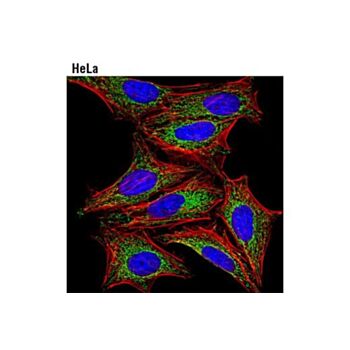
| Size | 100 µl |
| Reactivity | H Mk |
| Sensitivity | Endogenous |
| Molecular Weight (kDa) | 12 |
| Source/Isotype | Rabbit IgG |
| Application/Dilution | {Western Blotting: 1:1000, Immunoprecipitation: 1:100, Immunohistochemistry (Paraffin): 1:1600, Immunofluorescence (Immunocytochemistry): 1:3200} |
| Storage | Supplied in 10 mM sodium HEPES (pH 7.5), 150 mM NaCl, 100 µg/ml BSA, 50% glycerol and less than 0.02% sodium azide. Store at –20°C. Do not aliquot the antibody. |
| Specificity/Sensitivity | ATPIF1 (D6P1Q) XP® Rabbit mAb recognizes endogenous levels of total ATPIF1 protein. |
| Species Reactivity | Human, Monkey |
| Source/Purification | Monoclonal antibody is produced by immunizing animals with a synthetic peptide corresponding to residues surrounding Ala46 of human ATPIF1 protein. |
| Background | The ATPase inhibitor factor 1 (ATPIF1) gene encodes a mitochondrial ATPase inhibitor that limits ATP depletion when mitochondrial respiration is impaired (1). ATPIF1 becomes activated following a drop in pH, binding to β-F1-ATPase, thereby inhibiting the hydrolase activity of the H+-ATP synthase (1,2). In addition to its role as an ATP hydrolase, ATPIF1 has also been shown to play a regulatory role in cellular energy metabolism by triggering the induction of aerobic glycolysis in cancer cells resulting in their Warburg phenotype (3,4). Research studies demonstrate that the overexpression of ATPIF1 in several human carcinomas further supports its participation in oncogenesis and provides insight into the altered metabolism of cancer cells, which includes the reprogramming of energetic metabolism toward glycolysis (3). |
| SKU | CSIG-13268S |
|---|---|
| Featured | No |
| Supplier Part Number | 13268S |
| UM | EA |
| UNSPSC | 12352203 |
| Manufacturer | Cell Signaling |
| MSDS URL | Click here |
| Temperature | -20C |
| CountryOfOrigin | United States |
| ProductLine | CSIG |
| Qty | 1 |
| MinOrderQty | 1 |
| Weight | 7.000000 |
| Lead Time | 5 |
| Hazardous | N |
| ACT Ecolabel | No |