We use cookies to make your experience better. To comply with the new e-Privacy directive, we need to ask for your consent to set the cookies. Learn about our cookie policy.

Cell Signaling Gabarapl2 (D1w9t) Rabbit mAb
List Price $354.51 Your Price $354.51
Cell Signaling Gabarapl2 (D1w9t) Rabbit mAb - CSIG (Additional S&H or Hazmat Fees May Apply)
NETA PART: CSIG-14256S
MFG.PART: 14256S
UNSPSC: 41116133
Manufacturer: Cell Signaling


| Size | 100 µl |
| Reactivity | H M R Mk |
| Sensitivity | Endogenous |
| Molecular Weight (kDa) | 14 |
| Source/Isotype | Rabbit IgG |
| Application/Dilution | {Western Blotting: 1:1000} |
| Storage | Supplied in 10 mm sodium HEPES (pH 7.5), 150 mm NaCl, 100 µg/mL BSA, 50% glycerol and less than 0.02% sodium azide. Store at –20°C. Do not aliquot the antibody. |
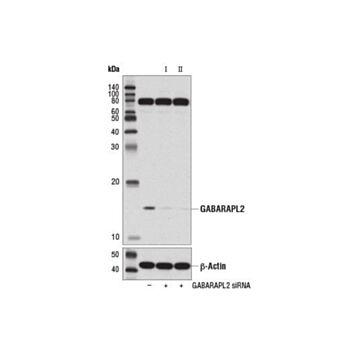
| Specificity/Sensitivity | GABARAPL2 (D1W9T) Rabbit mAb recognizes endogenous levels of total GABARAPL2 protein. Bands of unknown origin are detected at 80 and 110 kDa in some cell lines. This antibody has a preference for the Type I form of GABARAPL2. |
| Species Reactivity | Human, Mouse, Rat, Monkey |
| Source/Purification | Monoclonal antibody is produced by immunizing animals with a synthetic peptide corresponding to residues near the carboxy terminus of human GABARAPL2 protein. |
| Background | GABAA receptor associated protein (GABARAP) is an Atg8 family protein with a key role in autophagy, which was originally discovered as a protein associated with the GABAA receptor regulating receptor trafficking to the plasma membrane (1). Proteins in this family, including microtubule-associated protein light chain 3 (LC3) and GATE-16 (GABARAPL2), become incorporated into the autophagosomal membranes following autophagic stimuli such as starvation (2). Like the other family members, GABARAP is cleaved at its carboxyl terminus, which leads to conjugation by either of the phospholipids phosphatidylethanolamine or phosphatidylserine (3,4). This processing converts GABARAP from a type I to a type II membrane bound form involved in autophagosome biogenesis. Processing of GABARAP involves cleavage by Atg4 family members (5,6) followed by conjugation by the E1 and E2 like enzymes Atg7 and Atg3 (7,8). GABARAPL1/GEC1, a protein that is highly related to GABARAP, was identified as an estrogen inducible gene, and is also associated with autophagosomes (9-11).GABARAPL2/GATE-16 was identified as a modulator of membrane transport, interacting with N-ethylmaleimide senstive factor (NSF) and the Golgi v-SNARE GOS-28 (12). In addition, GABARAPL2 interacts with OSBP-related protein 7 (ORP7), the GTPase GIMAP6, and the calcium channel TRPML3. (13-15) |
| SKU | CSIG-14256S |
|---|---|
| Supplier Part Number | 14256S |
| UM | EA |
| UNSPSC | 41116133 |
| Manufacturer | Cell Signaling |
| MSDS URL | Click here |
| Temperature | -20C |
| CountryOfOrigin | United States |
| ProductLine | CSIG |
| Qty | 1 |
| MinOrderQty | 1 |
| Weight | 7.000000 |
| Lead Time | 5 |
| Hazardous | N |
| Energy Star | No |
| Green | No |
| Controlled | N |