We use cookies to make your experience better. To comply with the new e-Privacy directive, we need to ask for your consent to set the cookies. Learn more.

Cell Signaling Rb (4h1) Mouse mAb
List Price
$158.57
Your Price
$158.57
Cell Signaling Rb (4h1) Mouse mAb - CSIG (Additional S&H or Hazmat Fees May Apply)
NETA PART:
CSIG-9309T
MFG.PART:
9309T
UNSPSC:
41116111
Manufacturer:
Cell Signaling


| Size | 20 µl |
| Reactivity | H Mk B Pg |
| Sensitivity | Endogenous |
| Molecular Weight (kDa) | 110 |
| Source/Isotype | Mouse IgG2a |
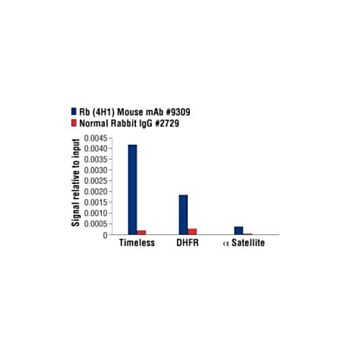
| Application/Dilution | {Western Blotting: 1:2000, Immunoprecipitation: 1:100, Immunohistochemistry (Paraffin): 1:400 - 1:1600, Immunofluorescence (Immunocytochemistry): 1:800 - 1:3200, Flow Cytometry (Fixed/Permeabilized): 1:200 - 1:800, Chromatin IP: 1:200} |
| Storage | Supplied in 10 mm sodium HEPES (pH 7.5), 150 mm NaCl, 100 µg/mL BSA, 50% glycerol and less than 0.02% sodium azide. Store at –20°C. Do not aliquot the antibody. For a carrier-free (BSA and azide free) version of this product see product #61121. |
| Specificity/Sensitivity | Rb (4H1) Mouse mAb detects endogenous levels of total Rb protein. The antibody does not cross-react with the Rb homologues p107 or p130, or with other proteins. |
| Species Reactivity | Human, Monkey, Bovine, Pig |
| Source/Purification | Monoclonal antibody is produced by immunizing animals with a Rb-C fusion protein containing residues 701-928 of human Rb. The epitope corresponds to a region surrounding His890 of human Rb. |
| Background | The retinoblastoma tumor suppressor protein Rb regulates cell proliferation by controlling progression through the restriction point within the G1-phase of the cell cycle (1). Rb has three functionally distinct binding domains and interacts with critical regulatory proteins including the E2F family of transcription factors, c-Abl tyrosine kinase, and proteins with a conserved LXCXE motif (2-4). Cell cycle-dependent phosphorylation by a CDK inhibits Rb target binding and allows cell cycle progression (5). Rb inactivation and subsequent cell cycle progression likely requires an initial phosphorylation by cyclin D-CDK4/6 followed by cyclin E-CDK2 phosphorylation (6). Specificity of different CDK/cyclin complexes has been observed in vitro (6-8) and cyclin D1 is required for Ser780 phosphorylation in vivo (9). |
| SKU | CSIG-9309T |
|---|---|
| Supplier Part Number | 9309T |
| UM | EA |
| UNSPSC | 41116111 |
| Manufacturer | Cell Signaling |
| MSDS URL | Click here |
| Temperature | -20C |
| CountryOfOrigin | United States |
| ProductLine | CSIG |
| Qty | 1 |
| MinOrderQty | 1 |
| Weight | 7.000000 |
| Lead Time | 5 |
| Hazardous | N |
| Energy Star | No |
| Green | No |
| Controlled | N |