


Special Offers
100% Performance Guaranteed
Key Specifications Table
| Species Reactivity | Key Applications | Host | Format | Antibody Type |
|---|---|---|---|---|
| R, M | WB, IF, IH(P) | Gp | Serum | Polyclonal Antibody |
| Description | |
|---|---|
| Catalogue Number | AB2253 |
| Replaces | AB5910 |
| Description | Anti-Doublecortin Antibody |
| Alternate Names |
|
| Background Information | Neuronal migration protein doublecortin (UniProt: O88809; also known as Doublin, Lissencephalin-X, Lis-X) is encoded by the Dcx (also known as Dcn) gene (Gene ID: 13193) in murine species. Doublecortin is a microtubule-associated protein that is expressed almost exclusively in immature neurons. Hence, it has emerged as an important marker of neurogenesis. It is highly expressed in newly produced cells in the neurogenic zones; the sub ventricular zone along the lateral ventricle, and the sub-granular zone (SGZ) of the dentate gyrus. Doublecortin binds to microtubules in migrating cells and as a result promote the movement of these cells. It is reported to direct neuronal migration by regulating the organization and stability of microtubules. Its phosphorylation by MARK1, MARK2, CDK5, and PKA regulates its ability to bind microtubules. Phosphorylation at serine 265 and serine 297 is reported to occur mainly in the neonatal brain and the level of Doublecortin and its phosphorylation declines significantly by postnatal day 21. Mutations in Dcx gene are reported to cause abnormal migration of neurons during development that disrupt the layering of the cortex, leading to epilepsy, cognitive disability, subcortical band heterotopia. Doublecortin may also be involved in cancer metastasis where unstable interactions between doublecortin and microtubules destabilize cytoskeletal organization leading to disorganized movements of cells that can lead to the uncontrolled migration of cancer cells. (Ref.: Ayanlaja, A.A., et al. (2017). Front. Mol. Neurosci. 10; 199; Graham, ME., et al. (2004). Biochem. J. 381(2); 471-481). |
| Product Information | |
|---|---|
| Format | Serum |
| Control |
|
| Presentation | Purified guinea pig polyclonal antibody in buffer containing serum with 0.1 M Tris-Glycine (pH 7.4), 150 mM NaCl with 0.05% sodium azide |
| Quality Level | MQ100 |
| Applications | |
|---|---|
| Application | Anti-Doublecortin, Cat. No. AB2253, is a guinea pig polyclonal antibody that detects Doublecortin and is tested for use in Immunohistochemistry (Paraffin) and Immunofluorescence, and Western Blotting. |
| Key Applications |
|
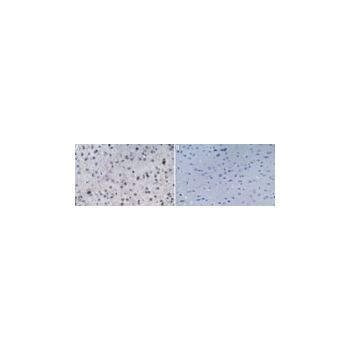
| Application Notes | Immunofluorescence Analysis: A 1:250 dilution from a representative lot detected Doublecortin in Mouse cerebellum tissue sections. Immunohistochemistry (Paraffin) Analysis: A 1:250 dilution from a representative lot detected Doublecortin in Mouse and Rat cerebral cortex tissue sections. Note: Actual optimal working dilutions must be determined by end user as specimens, and experimental conditions may vary with the end user. |
| Biological Information | |
|---|---|
| Immunogen | KLH-conjugated linear peptide corresponding to 16 amino acids from the C-terminal region of mouse Doublecortin. |
| Epitope | C-Terminus |
| Host | Guinea Pig |
| Specificity | This guinea pig polyclonal antibody specifically detects Doublecortin. It targets an epitope within 16 amino acids from the C-terminal region. |
| Species Reactivity |
|
| Species Reactivity Note | Mouse, Rat. Predicted to react with Human based on 100% sequence homology. |
| Antibody Type | Polyclonal Antibody |
| Entrez Gene Number |
|
| Entrez Gene Summary | In the developing cortex, cortical neurons must migrate over long distances to reach the site of their final differentiation. The protein encoded by this gene is a cytoplasmic protein which appears to direct neuronal migration by regulating the organization and stability of microtubules. The encoded protein contains two doublecortin domains, which bind microtubules. In addition, the encoded protein interacts with LIS1, the regulatory gamma subunit of platelet activating factor acetylhydrolase, and this interaction is important to proper microtubule function in the developing cortex. Mutations in this gene are a cause of X-linked lissencephaly. Multiple transcript variants encoding at least three different isoforms have been found for this gene. [provided by RefSeq] |
| Gene Symbol |
|
| Purification Method | GST Depletion |
| UniProt Number |
|
| UniProt Summary | FUNCTION: Seems to be required for initial steps of neuronal dispersion and cortex lamination during cerebral cortex development. May act by competing with the putative neuronal protein kinase DCAMKL1 in binding to a target protein. May in that way participate in a signaling pathway that is crucial for neuronal interaction before and during migration, possibly as part of a calcium ion-dependent signal transduction pathway. May be part with LIS-1 of an overlapping, but distinct, signaling pathways that promote neuronal migration. SUBUNIT STRUCTURE: Interacts with tubulin. SUBCELLULAR LOCATION: Cytoplasm. TISSUE SPECIFICITY: Highly expressed in neuronal cells of fetal brain (in the majority of cells of the cortical plate, intermediate zone and ventricular zone), but not expressed in other fetal tissues. In the adult, highly expressed in the brain frontal lobe, but very low expression in other regions of brain, and not detected in heart, placenta, lung, liver, skeletal muscles, kidney and pancreas. DISEASE: Defects in DCX are the cause of lissencephaly X-linked type 1 (LISX1) [MIM:300067]; also called X-LIS or LIS. LISX1 is a classic lissencephaly characterized by mental retardation and seizures that are more severe in male patients. Affected boys show an abnormally thick cortex with absent or severely reduced gyri. Clinical manifestations include feeding problems, abnormal muscular tone, seizures and severe to profound psychomotor retardation. Female patients display a less severe phenotype referred to as doublecortex. Ref.1 Ref.2 Ref.9 Ref.10 Ref.18 Ref.21 Defects in DCX are the cause of subcortical band heterotopia X-linked (SBHX) [MIM:300067]; also known as double cortex or subcortical laminar heterotopia (SCLH). SBHX is a mild brain malformation of the lissencephaly spectrum. It is characterized by bilateral and symmetric plates or bands of gray matter found in the central white matter between the cortex and cerebral ventricles, cerebral convolutions usually appearing normal. Ref.11 Ref.12 Ref.13 Ref.14 Ref.15 Ref.16 Ref.17 Ref.19 A chromosomal aberration involving DCX is found in lissencephaly. Translocation t(X;2)(q22.3;p25.1). SEQUENCE SIMILARITY: Contains 2 doublecortin domains. |
| Molecular Weight | Target molecular weight ~42 kDa observed;40.61 kDa calculated. Uncharacterized bands may be observed in some lysate(s). |
| Product Usage Statements | |
|---|---|
| Quality Assurance | Evaluated by Western Blotting in Rat brain tissue lysate. Western Blotting Analysis: A 1:1,000 dilution of this antibody detected Doublecortin in Rat brain tissue lysate. |
| Usage Statement |
|
| Storage and Shipping Information | |
|---|---|
| Storage Conditions | Store at -10°C to -25°C. Handling Recommendations: Upon receipt and prior to removing the cap, centrifuge the vial and gently mix the solution. Aliquot into microcentrifuge tubes and store at -20°C. Avoid repeated freeze/thaw cycles, which may damage IgG and affect product performance. |
| Packaging Information | |
|---|---|
| Material Size | 50 µL |