We use cookies to make your experience better. To comply with the new e-Privacy directive, we need to ask for your consent to set the cookies. Learn more.

Cell Signaling Pannexin-1 (D9m1c) Rabbit mAb
List Price
$342.39
Your Price
$342.39
Cell Signaling Pannexin-1 (D9m1c) Rabbit mAb - CSIG (Additional S&H or Hazmat Fees May Apply)
NETA PART:
CSIG-91137S
MFG.PART:
91137S
UNSPSC:
41116113
Manufacturer:
Cell Signaling


| Size | 100 µl |
| Reactivity | H M R |
| Sensitivity | Endogenous |
| Molecular Weight (kDa) | 45-55, 19 |
| Source/Isotype | Rabbit IgG |
| Application/Dilution | {Western Blotting: 1:1000, Immunoprecipitation: 1:100} |
| Storage | Supplied in 10 mM sodium HEPES (pH 7.5), 150 mM NaCl, 100 µg/ml BSA, 50% glycerol and less than 0.02% sodium azide. Store at –20°C. Do not aliquot the antibody. |
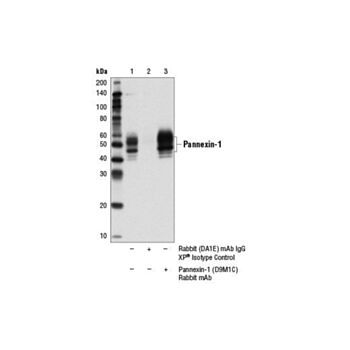
| Specificity/Sensitivity | Pannexin-1 (D9M1C) Rabbit mAb recognizes endogenous levels of total pannexin-1 protein. This antibody detects an amino-terminal pannexin-1 fragment produced by caspase cleavage. |
| Species Reactivity | Human, Mouse, Rat |
| Source/Purification | Monoclonal antibody is produced by immunizing animals with a synthetic peptide corresponding to residues near the amino terminus of human pannexin-1 protein. |
| Background | The pannexin family (pannexin-1, -2, and -3; PANX1-3) of gap junction proteins has homology to the invertebrate innexins and display distinct expression patterns (1). Pannexin-1 is widely expressed, with highest expression in the heart, brain, skeletal muscle, testis, and ovary (1,2). Pannexin-2 is predominately expressed in the brain (1,2) and pannexin-3 is found within the skin and connective tissues (1,3). Connexin family gap junction proteins form hemichannels that align adjacent cells, creating functional intercellular channels that are permeable to ions and small molecules. In contrast, pannexin proteins may not function as gap junction proteins since pannexins on adjacent cells may not align to form complete channels (3). These pannexin “hemichannels” may play a role in inflammation, apoptosis, and neuronal signaling by allowing permeability of ions, ATP, and potentially other small molecules into the extracellular space (4-6). Pannexin-1 can be activated by effector caspases (caspase-3 and -7), which leads to release of signal molecules that promote phagocytosis of apoptotic cells (7). |
| SKU | CSIG-91137S |
|---|---|
| Featured | No |
| Supplier Part Number | 91137S |
| UM | EA |
| UNSPSC | 41116113 |
| Manufacturer | Cell Signaling |
| MSDS URL | Click here |
| Temperature | -20C |
| CountryOfOrigin | United States |
| ProductLine | CSIG |
| Qty | 1 |
| MinOrderQty | 1 |
| Weight | 7.000000 |
| Lead Time | 5 |
| Hazardous | N |
| ACT Ecolabel | No |