We use cookies to make your experience better. To comply with the new e-Privacy directive, we need to ask for your consent to set the cookies. Learn about our cookie policy.

Cell Signaling Yap (D8h1x) Xp Rabbit mAb (Hrp Conjugate)
List Price
$475.71
Your Price
$475.71
Cell Signaling Yap (D8h1x) Xp Rabbit mAb (Hrp Conjugate) - CSIG (Additional S&H or Hazmat Fees May Apply)
NETA PART:
CSIG-15028S
MFG.PART:
15028S
UNSPSC:
41116111
Manufacturer:
Cell Signaling


| Size | 100 µl |
| Reactivity | H M R Hm Mk |
| Sensitivity | Endogenous |
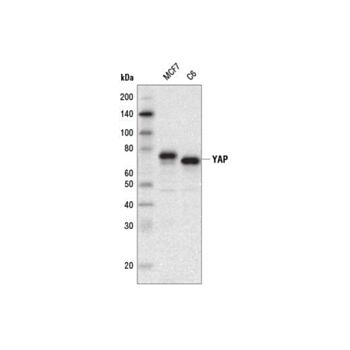
| Molecular Weight (kDa) | 65-78 |
| Source/Isotype | Rabbit IgG |
| Application/Dilution | {Western Blotting: 1:1000} |
| Storage | Supplied in 136 mm NaCl, 2.6 mm KCl, 12 mm sodium phosphate (pH 7.4) dibasic, 2 mg/mL BSA, and 50% glycerol. Store at –20°C. Do not aliquot the antibodies. |
| Specificity/Sensitivity | YAP (D8H1X) XP® Rabbit mAb (HRP Conjugate) recognizes endogenous levels of total YAP protein. |
| Species Reactivity | Human, Mouse, Rat, Hamster, Monkey |
| Source/Purification | Monoclonal antibody is produced by immunizing animals with recombinant protein specific to the carboxy terminus of human YAP protein. The epitope corresponds to a region surrounding Pro435 of human YAP isoform 1. This sequence region is 100% conserved among all known isoforms of human YAP protein. |
| Background | YAP (Yes-associated protein, YAP65) was first identified based on its ability to associate with the SH3 domain of Yes. It also binds to other SH3 domain-containing proteins such as Nck, Crk, Src, and Abl (1). In addition to the SH3 binding motif, YAP contains a PDZ interaction motif, a coiled-coil domain, and WW domains (2-4). While initial studies of YAP all pointed towards a role in anchoring and targeting to specific subcellular compartments, subsequent studies showed that YAP is a transcriptional co-activator by virtue of its WW domain interacting with the PY motif (PPxY) of the transcription factor PEBP2 and other transcription factors (5). In its capacity as a transcriptional co-activator, YAP is now widely recognized as a central mediator of the Hippo Pathway, which plays a fundamental and widely conserved role in regulating tissue growth and organ size (6-8). Phosphorylation at multiple sites (e.g., Ser109, Ser127) by LATS kinases promotes YAP translocation from the nucleus to the cytoplasm, where it is sequestered through association with 14-3-3 proteins (7-9). These LATS-driven phosphorylation events serve to prime YAP for subsequent phosphorylation by CK1δ/ε in an adjacent phosphodegron, triggering proteasomal degradation of YAP (10). |
| SKU | CSIG-15028S |
|---|---|
| Supplier Part Number | 15028S |
| UM | EA |
| UNSPSC | 41116111 |
| Manufacturer | Cell Signaling |
| MSDS URL | Click here |
| Temperature | -20C |
| CountryOfOrigin | United States |
| ProductLine | CSIG |
| Qty | 1 |
| MinOrderQty | 1 |
| Weight | 7.000000 |
| Lead Time | 5 |
| Hazardous | N |
| Energy Star | No |
| Green | No |
| Controlled | N |