


Special Offers
100% Performance Guaranteed
Key Specifications Table
| Species Reactivity | Key Applications | Host | Format | Antibody Type |
|---|---|---|---|---|
| H, R | IHC | Rb | Serum | Polyclonal Antibody |
| Description | |
|---|---|
| Catalogue Number | AB5864 |
| Brand Family | Chemicon® |
| Trade Name |
|
| Description | Anti-Myelin Basic Protein Antibody |
| Alternate Names |
|
| Product Information | |
|---|---|
| Format | Serum |
| Control |
|
| Presentation | Rabbit Serum. Lyophilized, no preservatives. Reconstitute with 50 μL of sterile distilled water. Centrifuge to remove any residue. |
| Quality Level | MQ100 |
| Applications | |
|---|---|
| Application | Anti-Myelin Basic Protein Antibody is an antibody against Myelin Basic Protein for use in IH. |
| Key Applications |
|
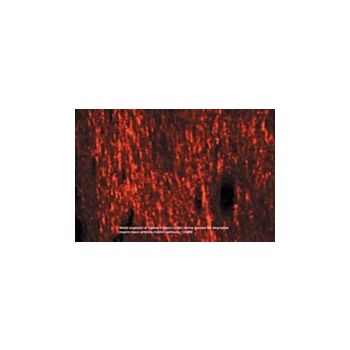
| Application Notes | Immunohistochemistry: 1:2,000. Immunostains myelin basic protein of abnormal appearing oligodendrocytic processes and cell bodies in demyelinating areas. The antibody recognizes only areas of myelin degeneration when tested in injured spinal cord and lesioned sciatic nerve. It also stains discrete white matter in brain of multiple system atrophy Optimal working dilutions must be determined by the end user. |
| Biological Information | |
|---|---|
| Immunogen | Synthetic peptide corresponding to amino acids 69-86 of the guinea pig protein. Immunogen corresponds to "degraded" Myelin Basic Protein: YGSLPQKSQRSQDENPVV |
| Concentration | Please refer to the Certificate of Analysis for the lot-specific concentration. |
| Host | Rabbit |
| Specificity | Recognizes Myelin Basic Protein in demyelinated nerve tissues. Immunohistochemistry analysis of lesioned rat spinal cord shows a high level of specificity for this antiserum. |
| Species Reactivity |
|
| Antibody Type | Polyclonal Antibody |
| Entrez Gene Number |
|
| Entrez Gene Summary | The protein encoded by the classic MBP gene is a major constituent of the myelin sheath of oligodendrocytes and Schwann cells in the nervous system. However, MBP-related transcripts are also present in the bone marrow and the immune system. These mRNAs arise from the long MBP gene (otherwise called "Golli-MBP") that contains 3 additional exons located upstream of the classic MBP exons. Alternative splicing from the Golli and the MBP transcription start sites gives rise to 2 sets of MBP-related transcripts and gene products. The Golli mRNAs contain 3 exons unique to Golli-MBP, spliced in-frame to 1 or more MBP exons. They encode hybrid proteins that have N-terminal Golli aa sequence linked to MBP aa sequence. The second family of transcripts contain only MBP exons and produce the well characterized myelin basic proteins. This complex gene structure is conserved among species suggesting that the MBP transcription unit is an integral part of the Golli transcription unit and that this arrangement is important for the function and/or regulation of these genes. |
| Gene Symbol |
|
| Purification Method | Unpurified |
| UniProt Number |
|
| UniProt Summary | FUNCTION: Is, with PLP, the most abundant protein component of the myelin membrane in the CNS. Has a role in both the formation and stabilization of this compact multilayer arrangement of bilayers. Each splice variant and charge isomer may have a specialized function in the assembly of an optimized, biochemically functional myelin membrane (By similarity). SIZE: 167 amino acids; 18213 Da SUBUNIT: Homodimer TISSUE SPECIFICITY: Found in both the central and the peripheral nervous system. PTM: At least 5 charge isomers; C1 (the most cationic, least modified, and most abundant form), C2, C3, C4 and C5 (the least cationic form); are produced as a result of optional post-translational modifications such as phosphorylation of serine or threonine residues, deamidation of glutamine or asparagine residues, citrullination and methylation of arginine residues. C1 and C2 are unphosphorylated, C3 and C4 are monophosphorylated and C5 is phosphorylated at two positions (PubMed: 51849) |
| Product Usage Statements | |
|---|---|
| Usage Statement |
|
| Storage and Shipping Information | |
|---|---|
| Storage Conditions | Maintain at -20 to -70°C in undiluted aliquots for up to 12 months after date of receipt. Avoid repeated freeze/thaw cycles. Glycerol (1:1) can be added for additional stability. |
| Packaging Information | |
|---|---|
| Material Size | 50 µL |