We use cookies to make your experience better. To comply with the new e-Privacy directive, we need to ask for your consent to set the cookies. Learn about our cookie policy.

Cell Signaling Nlrx1 (D4m3z) Rabbit mAb
List Price $420.16 Your Price $420.16
Cell Signaling Nlrx1 (D4m3z) Rabbit mAb - CSIG (Additional S&H or Hazmat Fees May Apply)
NETA PART: CSIG-13829S
MFG.PART: 13829S
UNSPSC: 41116124
Manufacturer: Cell Signaling


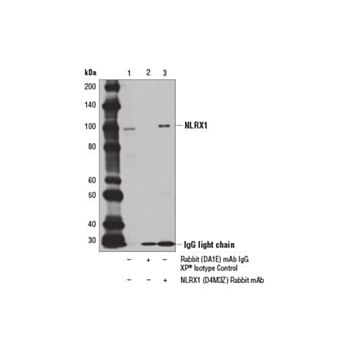
| Size | 100 µl |
| Reactivity | H M R |
| Sensitivity | Endogenous |
| Molecular Weight (kDa) | 100 |
| Source/Isotype | Rabbit IgG |
| Application/Dilution | {Western Blotting: 1:1000, Immunoprecipitation: 1:50} |
| Storage | Supplied in 10 mm sodium HEPES (pH 7.5), 150 mm NaCl, 100 µg/mL BSA, 50% glycerol and less than 0.02% sodium azide. Store at –20°C. Do not aliquot the antibody. |
| Specificity/Sensitivity | NLRX1 (D4M3Z) Rabbit mAb recognizes endogenous levels of total NLRX1 protein. |
| Species Reactivity | Human, Mouse, Rat |
| Source/Purification | Monoclonal antibody is produced by immunizing animals with a synthetic peptide corresponding to residues surrounding Val437 of human NLRX1 protein. |
| Background | The nucleotide-binding oligomerization domain (NOD)-like receptor (NLR) family of proteins is a diverse family of cytoplasmic innate immune receptors. They are characterized by the presence of an amino-terminal effector domain, which is often either a caspase activation and recruitment domain (CARD) or a pyrin domain (PYD), followed by a NACHT domain and carboxy-terminal leucine-rich-repeats (LRR) involved in recognition of pathogen-associated molecular patterns (PAMPs) (1). NLR proteins play a variety of roles during the innate immune response including pathogen sensing, transcriptional activation of proinflammatory cytokines through NF-κB, transcriptional activation of type I interferons through IRFs, and formation of inflammasomes leading to activation of inflammatory caspases (1-7).NLRX1 (CLR11.3/NOD26/NOD5/NOD9) is unique among NLR family members in that it contains an amino-terminal mitochondrial targeting sequence resulting in localization to the mitochondria (8,9). In contrast to most NLR proteins, NLRX1 has been shown to act as a negative regulator of innate immune responses through inhibition of MAVS-Rig-I signaling, as well as inhibition of Toll-like receptor (TLR)-mediated NF-κB activation (9-11). In addition, overexpression of NLRX1 enhanced the production of reactive oxygen species (ROS), resulting in prolonged NF-κB and JNK signaling in response to TNF-α (8). |
| SKU | CSIG-13829S |
|---|---|
| Supplier Part Number | 13829S |
| UM | EA |
| UNSPSC | 41116124 |
| Manufacturer | Cell Signaling |
| MSDS URL | Click here |
| Temperature | -20C |
| CountryOfOrigin | United States |
| ProductLine | CSIG |
| Qty | 1 |
| MinOrderQty | 1 |
| Weight | 7.000000 |
| Lead Time | 5 |
| Hazardous | N |
| Energy Star | No |
| Green | No |
| Controlled | N |