We use cookies to make your experience better. To comply with the new e-Privacy directive, we need to ask for your consent to set the cookies. Learn more.

Cell Signaling Spi-B (D4v9s) Rabbit mAb
List Price
$402.99
Your Price
$402.99
Cell Signaling Spi-B (D4v9s) Rabbit mAb - CSIG (Additional S&H or Hazmat Fees May Apply)
NETA PART:
CSIG-14337S
MFG.PART:
14337S
UNSPSC:
41116124
Manufacturer:
Cell Signaling


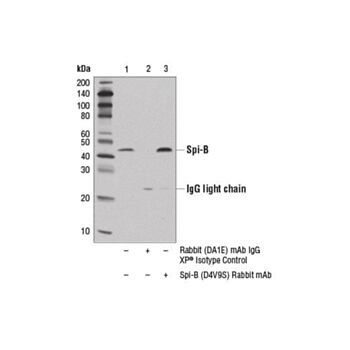
| Size | 100 µl |
| Reactivity | H M |
| Sensitivity | Endogenous |
| Molecular Weight (kDa) | 44 |
| Source/Isotype | Rabbit IgG |
| Application/Dilution | {Western Blotting: 1:1000, Immunoprecipitation: 1:100} |
| Storage | Supplied in 10 mM sodium HEPES (pH 7.5), 150 mM NaCl, 100 µg/ml BSA, 50% glycerol and less than 0.02% sodium azide. Store at –20°C. Do not aliquot the antibody. |
| Specificity/Sensitivity | Spi-B (D4V9S) Rabbit mAb recognizes endogenous levels of total Spi-B protein. |
| Species Reactivity | Human, Mouse |
| Source/Purification | Monoclonal antibody is produced by immunizing animals with a synthetic peptide corresponding to residues near the carboxy terminus of human Spi-B protein. |
| Background | Spi-B belongs to the ETS family of transcription factors and activates transcription through direct binding to the PU box (1). Spi-B was identified based on its homology with PU.1/Spi-I (1). The function of Spi-B is most well studied in B cells and plasmacytoid dendritic cells (pDCs). B cells from mice deficient in Spi-B proliferate poorly and die in response to signaling through the B cell receptor (2). In addition, Spi-B(-/-) mice have a defect in germinal center formation (2). Spi-B plays a role in both the development and function of pDCs. It is highly expressed by pDCs and not by monocyte-derived DCs, and overexpression of Spi-B in hematopoietic progenitor cells inhibits development of other lymphoid lineages (3). pDCs from Spi-B(-/-) mice produce less interferon in response to TLR7 and TLR9 stimulation and have lower expression of pDC-specific surface markers (4). Finally, Spi-B is required for differentiation of intestinal microfold cells (5,6). |
| SKU | CSIG-14337S |
|---|---|
| Featured | No |
| Supplier Part Number | 14337S |
| UM | EA |
| UNSPSC | 41116124 |
| Manufacturer | Cell Signaling |
| MSDS URL | Click here |
| Temperature | -20C |
| CountryOfOrigin | United States |
| ProductLine | CSIG |
| Qty | 1 |
| MinOrderQty | 1 |
| Weight | 7.000000 |
| Lead Time | 5 |
| Hazardous | N |
| ACT Ecolabel | No |