We use cookies to make your experience better. To comply with the new e-Privacy directive, we need to ask for your consent to set the cookies. Learn about our cookie policy.

Cell Signaling Ptpn22 (D6d1h) Rabbit mAb
List Price $413.09 Your Price $413.09
Cell Signaling Ptpn22 (D6d1h) Rabbit mAb - CSIG (Additional S&H or Hazmat Fees May Apply)
NETA PART: CSIG-14693S
MFG.PART: 14693S
UNSPSC: 41116124
Manufacturer: Cell Signaling


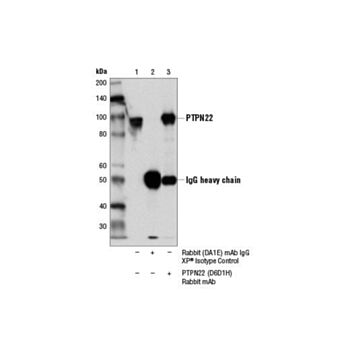
| Size | 100 µl |
| Reactivity | H M |
| Sensitivity | Endogenous |
| Molecular Weight (kDa) | 98 |
| Source/Isotype | Rabbit IgG |
| Application/Dilution | {Western Blotting: 1:1000, Immunoprecipitation: 1:100} |
| Storage | Supplied in 10 mm sodium HEPES (pH 7.5), 150 mm NaCl, 100 µg/mL BSA, 50% glycerol and less than 0.02% sodium azide. Store at –20°C. Do not aliquot the antibody. |
| Specificity/Sensitivity | PTPN22 (D6D1H) Rabbit mAb recognizes endogenous levels of total PTPN22 protein. |
| Species Reactivity | Human, Mouse |
| Source/Purification | Monoclonal antibody is produced by immunizing animals with a synthetic peptide corresponding to residues surrounding Pro451 of human PTPN22 protein. |
| Background | PTPN22 (Lyp/PEP) is a cytoplasmic phosphatase expressed by hematopoietic cells (1,2). PTPN22 associates with the tyrosine kinase Csk to inhibit T cell receptor signaling through inactivation of Src kinases (3,4). Csk phosphorylates Src kinases on an inhibitory tyrosine, while PTPN22 dephosphorylates an activating site (4). PTPN22(-/-) mice have higher levels of activated Lck than wild-type, resulting in greater T cell expansion and increased serum antibody levels (5). Research studies have shown that a single-nucleotide polymorphism, 1858T of the PTPN22 gene which encodes the amino acid substitution R620W, confers increased risk for multiple autoimmune diseases including type I diabetes, rheumatoid arthritis, systemic lupus erythematosus, and Graves disease (6-9). Interestingly, although the R620W substitution disrupts the interaction between Csk and PTPN22, it is actually a gain-of-function mutation resulting in increased phosphatase activity (6,10,11). Recent evidence suggests that the autoimmune phenotype associated with the R620W variant is the result of increased calpain-mediated degradation and decreased protein levels of PTPN22 (12). |
| SKU | CSIG-14693S |
|---|---|
| Supplier Part Number | 14693S |
| UM | EA |
| UNSPSC | 41116124 |
| Manufacturer | Cell Signaling |
| MSDS URL | Click here |
| Temperature | -20C |
| CountryOfOrigin | United States |
| ProductLine | CSIG |
| Qty | 1 |
| MinOrderQty | 1 |
| Weight | 7.000000 |
| Lead Time | 5 |
| Hazardous | N |
| Energy Star | No |
| Green | No |
| Controlled | N |