We use cookies to make your experience better. To comply with the new e-Privacy directive, we need to ask for your consent to set the cookies. Learn more.

Cell Signaling Glut1 (D3j3a) Rabbit mAb
List Price
$342.39
Your Price
$342.39
Cell Signaling Glut1 (D3j3a) Rabbit mAb - CSIG (Additional S&H or Hazmat Fees May Apply)
NETA PART:
CSIG-12939S
MFG.PART:
12939S
UNSPSC:
12352300
Manufacturer:
Cell Signaling


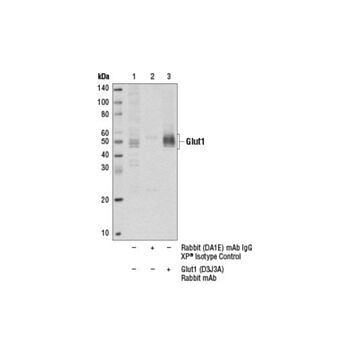
| Size | 100 µl |
| Reactivity | H M R |
| Sensitivity | Endogenous |
| Molecular Weight (kDa) | 45-60 |
| Source/Isotype | Rabbit IgG |
| Application/Dilution | {Western Blotting: 1:1000, Immunoprecipitation: 1:50} |
| Storage | Supplied in 10 mM sodium HEPES (pH 7.5), 150 mM NaCl, 100 µg/ml BSA, 50% glycerol and less than 0.02% sodium azide. Store at –20°C. Do not aliquot the antibody. |
| Specificity/Sensitivity | Glut1 (D3J3A) Rabbit mAb recognizes endogenous levels of total Glut1 protein. This antibody does not cross-react with Glut2, Glut3, or Glut4. |
| Species Reactivity | Human, Mouse, Rat |
| Source/Purification | Monoclonal antibody is produced by immunizing animals with a synthetic peptide corresponding to residues surrounding Leu260 of human Glut1 protein. |
| Background | Glucose transporter 1 (Glut1, SLC2A1) is a widely expressed transport protein that displays a broad range of substrate specificity in transporting a number of different aldose sugars as well as an oxidized form of vitamin C into cells (1,2). Glut1 is responsible for the basal-level uptake of glucose from the blood through facilitated diffusion (2). Research studies show that Glut1 and the transcription factor HIF-1α mediate the regulation of glycolysis by O-GlcNAcylation in cancer cells (3). Additional studies demonstrate that Glut1 is required for CD4 T cell activation and is critical for the expansion and survival of T effector (Teff) cells (4). Mutations in the corresponding SLC2A1 gene cause GLUT1 deficiency syndromes (GLUT1DS1, GLUT1DS2), a pair of neurologic disorders characterized by delayed development, seizures, spasticity, paroxysmal exercise-induced dyskinesia, and acquired microcephaly (5,6). Two other neurologic disorders - dystonia-9 (DYT9) and susceptibility to idiopathic generalized epilepsy 12 (EIG12) - are also caused by mutations in the SLC2A1 gene (7,8). |
| SKU | CSIG-12939S |
|---|---|
| Featured | No |
| Supplier Part Number | 12939S |
| UM | EA |
| UNSPSC | 12352300 |
| Manufacturer | Cell Signaling |
| MSDS URL | Click here |
| Temperature | -20C |
| CountryOfOrigin | United States |
| ProductLine | CSIG |
| Qty | 1 |
| MinOrderQty | 1 |
| Weight | 7.000000 |
| Lead Time | 5 |
| Hazardous | N |
| ACT Ecolabel | No |