We use cookies to make your experience better. To comply with the new e-Privacy directive, we need to ask for your consent to set the cookies. Learn more.

Cell Signaling Torc2/Crtc2 (5b10) Mouse mAb
List Price
$351.48
Your Price
$351.48
Cell Signaling Torc2/Crtc2 (5b10) Mouse mAb - CSIG (Additional S&H or Hazmat Fees May Apply)
NETA PART:
CSIG-13017S
MFG.PART:
13017S
UNSPSC:
12352300
Manufacturer:
Cell Signaling


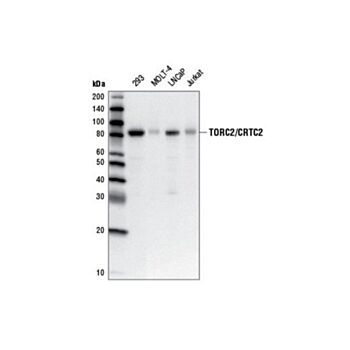
| Size | 100 µl |
| Reactivity | H |
| Sensitivity | Endogenous |
| Molecular Weight (kDa) | 80 |
| Source/Isotype | Mouse IgG1 |
| Application/Dilution | {Western Blotting: 1:1000} |
| Storage | Supplied in 10 mm sodium HEPES (pH 7.5), 150 mm NaCl, 100 µg/mL BSA, 50% glycerol and less than 0.02% sodium azide. Store at –20°C. Do not aliquot the antibody. |
| Specificity/Sensitivity | TORC2/CRTC2 (5B10) Mouse mAb recognizes endogenous levels of total TORC2/CRTC2 protein. |
| Species Reactivity | Human |
| Source/Purification | Monoclonal antibody is produced by immunizing animals with a recombinant fragment near the carboxy terminal of human TORC2/CRTC2 protein. |
| Background | Glucose homeostasis is regulated by hormones and cellular energy status. Elevations of blood glucose during feeding stimulate insulin release from pancreatic β-cells through a glucose sensing pathway. Feeding also stimulates release of gut hormones such as glucagon-like peptide-1 (GLP-1), which further induces insulin release, inhibits glucagon release and promotes β-cell viability. CREB-dependent transcription likely plays a role in both glucose sensing and GLP-1 signaling (1). The protein CRTC2 (CREB-regulated transcription coactivator 2)/TORC2 (transducer of regulated CREB activity 2) functions as a CREB co-activator (2,3) and is implicated in mediating the effects of these two pathways (4). In quiescent cells, CRTC2/TORC2 is phosphorylated at Ser171 and becomes sequestered in the cytoplasm via an interaction with 14-3-3 proteins. Glucose and gut hormones lead to the dephosphorylation of CRTC2/TORC2 and its dissociation from 14-3-3 proteins. Dephosphorylated CRTC2/TORC2 enters the nucleus to promote CREB-dependent transcription. CRTC2/TORC2 plays a key role in the regulation of hepatic gluconeogenic gene transcription in response to hormonal and energy signals during fasting (5).CRTC2/TORC2-related proteins CRTC1/TORC1 and CRTC3/TORC3 also act as CREB co-activators (2,3). CRTC1/TORC1, CRTC2/TORC2 and CRTC3/TORC3 associate with the HTLV Tax protein to promote Tax-dependent transcription of HTLV-1 long terminal repeats (6,7). CRTC1/TORC1 is highly phosphorylated at Ser151 in mouse hypothalamic cells under basal conditions (8). When these cells are exposed to cAMP or a calcium activator, CRTC1/TORC1 is dephosphorylated and translocates into the nucleus (8). CRTC1/TORC1 is essential for energy balance and fertility (8). |
| SKU | CSIG-13017S |
|---|---|
| Supplier Part Number | 13017S |
| UM | EA |
| UNSPSC | 12352300 |
| Manufacturer | Cell Signaling |
| MSDS URL | Click here |
| Temperature | -20C |
| CountryOfOrigin | United States |
| ProductLine | CSIG |
| Qty | 1 |
| MinOrderQty | 1 |
| Weight | 7.000000 |
| Lead Time | 5 |
| Hazardous | N |
| Energy Star | No |
| Green | No |
| Controlled | N |