We use cookies to make your experience better. To comply with the new e-Privacy directive, we need to ask for your consent to set the cookies. Learn about our cookie policy.

Cell Signaling Phospho-Prdx1 (Tyr194) (D1t9c) Rabbit mAb
List Price
$419.15
Your Price
$419.15
Cell Signaling Phospho-Prdx1 (Tyr194) (D1t9c) Rabbit mAb - CSIG (Additional S&H or Hazmat Fees May Apply)
NETA PART:
CSIG-14041S
MFG.PART:
14041S
UNSPSC:
12352300
Manufacturer:
Cell Signaling


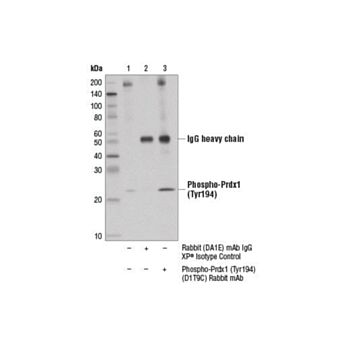
| Size | 100 µl |
| Reactivity | H |
| Sensitivity | Endogenous |
| Molecular Weight (kDa) | 21 |
| Source/Isotype | Rabbit IgG |
| Application/Dilution | {Western Blotting: 1:1000, Immunoprecipitation: 1:50} |
| Storage | Supplied in 10 mm sodium HEPES (pH 7.5), 150 mm NaCl, 100 µg/mL BSA, 50% glycerol and less than 0.02% sodium azide. Store at –20°C. Do not aliquot the antibody. |
| Specificity/Sensitivity | Phospho-Prdx1 (Tyr194) (D1T9C) Rabbit mAb recognizes endogenous levels of Prdx1 protein only when phosphorylated at Tyr194. This antibody may cross react with other activated receptor tyrosine kinases including EGFR. |
| Species Reactivity | Human |
| Source/Purification | Monoclonal antibody is produced by immunizing animals with a synthetic phosphopeptide corresponding to residues surrounding Tyr194 of human Prdx1 protein. |
| Background | Prdx1 belongs to a family of non-seleno peroxidases that function as H2O2 scavengers. All 6 Prdx isoforms share a conserved N-terminal cysteine (Cys51) that is oxidized by H2O2 to form cysteine-sulfenic acid (Cys51-SOH) and, in turn, reacts with Cys172-SH of another Prdx protein, forming a disulfide dimer and protecting it from degradation (1-3). Abnormally high levels of H2O2 cause Prdx1 to form an oligomeric chaperone that loses its peroxidase activity (4). Prdx family members have been reported to bind to JNK and c-Abl and regulate their kinase activity (5,6). Prdx1 was shown to bind to PTEN and regulate its phosphatase activity in conditions of mild or no cellular stress, hence preventing Akt-driven transformation by protecting PTEN from oxidation-induced inactivation (7).The transient phosphorylation of Prdx1 at Tyr194 leads to inactivation of Prdx1 that in turn promotes localized hydrogen peroxide accumulation (8). Evidence suggests that the Tyr194 phosphorylation of Prdx1 is prominent at the wound edge during repair of cutaneous injury in mice (8,9). |
| SKU | CSIG-14041S |
|---|---|
| Supplier Part Number | 14041S |
| UM | EA |
| UNSPSC | 12352300 |
| Manufacturer | Cell Signaling |
| MSDS URL | Click here |
| Temperature | -20C |
| CountryOfOrigin | United States |
| ProductLine | CSIG |
| Qty | 1 |
| MinOrderQty | 1 |
| Weight | 7.000000 |
| Lead Time | 5 |
| Hazardous | N |
| Energy Star | No |
| Green | No |
| Controlled | N |