We use cookies to make your experience better. To comply with the new e-Privacy directive, we need to ask for your consent to set the cookies. Learn more.

Cell Signaling Fto Antibody
List Price
$309.06
Your Price
$309.06
Cell Signaling Fto Antibody - CSIG (Additional S&H or Hazmat Fees May Apply)
NETA PART:
CSIG-14386S
MFG.PART:
14386S
UNSPSC:
12352300
Manufacturer:
Cell Signaling


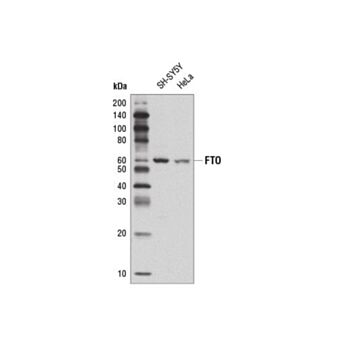
| Size | 100 µl |
| Reactivity | H |
| Sensitivity | Endogenous |
| Molecular Weight (kDa) | 60 |
| Source/Isotype | Rabbit |
| Application/Dilution | {Western Blotting: 1:1000} |
| Storage | Supplied in 10 mM sodium HEPES (pH 7.5), 150 mM NaCl, 100 µg/ml BSA and 50% glycerol. Store at –20°C. Do not aliquot the antibody. |
| Specificity/Sensitivity | FTO Antibody recognizes endogenous levels of total FTO protein. |
| Species Reactivity | Human |
| Source/Purification | Polyclonal antibodies are produced by immunizing animals with a synthetic peptide corresponding to residues surrounding Leu464 of human FTO protein. Antibodies are purified by protein A and peptide affinity chromatography. |
| Background | FTO (fat mass and obesity-associated protein) is the first obesity gene product identified by genome-wide association studies and it is associated with the largest effect size for this class of proteins (1-4). Multiple single-nucleotide polymorphisms (SNPs) in the first intron of the FTO gene have been associated with increased body weight and obesity. Further studies reported that FTO risk alleles were associated with an increase in energy intake, a reduction of activity, and possibly an increased daily fat intake (4).FTO is a DNA and RNA demethylase that catalyzes the oxidative demethylation of thymidine and uracil. Among its targets is an mRNA subset involved in regulation of learning, reward behavior, motor functions, and feeding (5). Loss of the FTO gene in mice leads to postnatal growth retardation and a significant reduction in adipose tissue. Mice deficient in the FTO gene have lean body mass due to increased energy expenditure and systemic activation of sympathetic neurons, while overexpression of FTO in mice leads to increased food intake and results in obesity. These results demonstrate that FTO is functionally involved in energy homeostasis (6-8). |
| SKU | CSIG-14386S |
|---|---|
| Featured | No |
| Supplier Part Number | 14386S |
| UM | EA |
| UNSPSC | 12352300 |
| Manufacturer | Cell Signaling |
| MSDS URL | Click here |
| Temperature | -20C |
| CountryOfOrigin | United States |
| ProductLine | CSIG |
| Qty | 1 |
| MinOrderQty | 1 |
| Weight | 7.000000 |
| Lead Time | 5 |
| Hazardous | N |
| ACT Ecolabel | No |