


Special Offers
100% Performance Guaranteed
Key Specifications Table
| Species Reactivity | Key Applications | Host | Format | Antibody Type |
|---|---|---|---|---|
| M, H | IHC | Rb | Affinity Purified | Polyclonal Antibody |
| Description | |
|---|---|
| Catalogue Number | AB2283 |
| Description | Anti-Tbr2 Antibody |
| Alternate Names |
|
| Background Information | Tbr2 (a T-domain transcription factor) is a member of a conserved protein family that shares a common DNA-binding domain, the T-box. T-box genes encode transcription factors involved in the regulation of developmental processes. Trb2 has been shown to play a role in the development of the neocortex and functions in the differentiation pathway of radial glia to postmitotic projection neuron. |
| Product Information | |
|---|---|
| Format | Affinity Purified |
| Control |
|
| Presentation | Purified rabbit polyclonal in buffer containing 0.1 M Tris-Glycine (pH 7.4, 150 mM NaCl) with 0.05% sodium azide. |
| Quality Level | MQ100 |
| Applications | |
|---|---|
| Application | This Anti-Tbr2 Antibody is validated for use in IH for the detection of Tbr2. |
| Key Applications |
|
| Biological Information | |
|---|---|
| Immunogen | KLH-conjugated linear peptide corresponding to mouse Tbr2. |
| Epitope | Internal Domain |
| Concentration | Please refer to the Certificate of Analysis for the lot-specific concentration. |
| Host | Rabbit |
| Specificity | This antibody recognizes Tbr2. |
| Species Reactivity |
|
| Species Reactivity Note | Proven to react with human and mouse. |
| Antibody Type | Polyclonal Antibody |
| Entrez Gene Number |
|
| Gene Symbol |
|
| Purification Method | Affinity Purfied |
| UniProt Number |
|
| UniProt Summary | FUNCTION: Functions as a transcriptional activator playing a crucial role during development. Functions in trophoblast differentiation and later in gastrulation, regulating both mesoderm delamination and endoderm specification. Plays a role in brain development being required for the specification and the proliferation of the intermediate progenitor cells and their progeny in the cerebral cortex. Also involved in the differentiation of CD8+ T-cells during immune response regulating the expression of lytic effector genes. SUBCELLULAR LOCATION: Nucleus Probable. TISSUE SPECIFICTY: Expressed in CD8+ T-cells. DEVELOPMENTAL STAGE: Originally expressed in the trophoectoderm of the blastocyst and later in the extra-embryonic ectoderm of the early post-implantation embryo. In the embryo proper, expressed in the posterior part of the epiblast. During gastrulation, extends distally into the primitive streak and nascent mesoderm. Also expressed in the developing forebrain and the olfactory lobes. Expressed at E12.5 and E14.5 in the forebrain. INDUCTION: Up-regulated in CD8+ T-cells upon activation. DISRUPTION PHENOTYPE: Embryonic lethal due to peri-implantation defects. Mutant embryos arrest soon after implantation and fail to form organized embryonic or extraembryonic structures. Conditional mutants, with expression abrogated in the inner cell mass of embryos from early implantation stages onward, display gastrulation defects. SEQUENCE SIMLARITIES: Contains 1 T-box DNA-binding domain. |
| Molecular Weight | N/A |
| Product Usage Statements | |
|---|---|
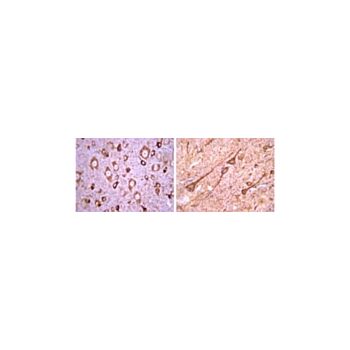
| Quality Assurance | Evaluated by Immunohistochemistry of human brain tissue. Immunohistochemistry Analysis: A 1:300 dilution of Anti-Tbr2 antibody from a previous lot detected Tbr2 in mouse and human brain tissue. |
| Usage Statement |
|
| Storage and Shipping Information | |
|---|---|
| Storage Conditions | Stable for 1 year at 2-8°C from date of receipt. |
| Packaging Information | |
|---|---|
| Material Size | 100 µg |