


Special Offers
100% Performance Guaranteed
Key Specifications Table
| Species Reactivity | Key Applications | Host | Format | Antibody Type |
|---|---|---|---|---|
| H, M, R, Fe, Ca, PO, B | ICC, IHC, IH(P), WB | Rb | Serum | Polyclonal Antibody |
| Description | |
|---|---|
| Catalogue Number | AB9568 |
| Replaces | 04-1112 |
| Brand Family | Chemicon® |
| Trade Name |
|
| Description | Anti-Neurofilament L Antibody |
| Background Information | Neurofilaments are a type of intermediate filament that serve as major elements of the cytoskeleton supporting the axon cytoplasm. They are the most abundant fibrillar components of the axon, being on average 3-10 times more frequent than axonal microtubules. Neurofilaments (10 nm in dia.) are built from three intertwined protofibrils which are themselves composed of two tetrameric protofilament complexes of monomeric proteins. The neurofilament triplet proteins (68/70, 160, and 200 kDa) occur in both the central and peripheral nervous system and are usually neuron specific. The 68/70 kDa NF-L protein can self-assemble into a filamentous structure, however the 160 kDa NF-M and 200 kDa NF-H proteins require the presence of the 68/70 kDa NF-L protein to co-assemble. Neuromas, ganglioneuromas, gangliogliomas, ganglioneuroblastomas and neuroblastomas stain positively for neurofilaments. Although typically restricted to neurons, neurofilaments have been detected in paragangliomas and adrenal and extra-adrenal pheochromocytomas. Carcinoids, neuroendocrine carcinomas of the skin, and oat cell carcinomas of the lung also express neurofilaments. |
| Product Information | |
|---|---|
| Format | Serum |
| Control |
|
| Presentation | Rabbit serum. Contains no preservative. |
| Quality Level | MQ100 |
| Applications | |
|---|---|
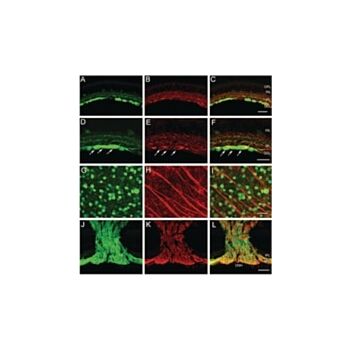
| Application | Detect Neurofilament L using this Anti-Neurofilament L Antibody validated for use in IC, IH, IH(P) & WB. |
| Key Applications |
|
| Application Notes | Western Blot Analysis: 1:1000 dilution of a previous lot detected NEUROFILAMENT L on 10 μg of mouse brain lysates. Immunocytochemistry: A 1:200-1:500 dilution of a previous lot was used in IC. Optimal working dilutions must be determined by the end user. |
| Biological Information | |
|---|---|
| Immunogen | Purified porcine NF-L |
| Concentration | Please refer to the Certificate of Analysis for the lot-specific concentration. |
| Host | Rabbit |
| Specificity | Recognizes Neurofilament-Light (NF-L) |
| Species Reactivity |
|
| Antibody Type | Polyclonal Antibody |
| Entrez Gene Number |
|
| Gene Symbol |
|
| Purification Method | Unpurified |
| UniProt Number |
|
| UniProt Summary | FUNCTION: SwissProt: P07196 # Neurofilaments usually contain three intermediate filament proteins: L, M, and H which are involved in the maintenance of neuronal caliber. SIZE: 543 amino acids; 61517 Da DOMAIN: SwissProt: P07196 The extra mass and high charge density that distinguish the neurofilament proteins from all other intermediate filament proteins are due to the tailpiece extensions. This region may form a charged scaffolding structure suitable for interaction with other neuronal components or ions. PTM: O-glycosylated (By similarity). DISEASE: SwissProt: P07196 # Defects in NEFL are the cause of Charcot-Marie-Tooth disease type 1F (CMT1F) [MIM:607734]. CMT1F is a form of Charcot- Marie-Tooth disease, the most common inherited disorder of the peripheral nervous system. Charcot-Marie-Tooth disease is classified in two main groups on the basis of electrophysiologic properties and histopathology: primary peripheral demyelinating neuropathy or CMT1, and primary peripheral axonal neuropathy or CMT2. Neuropathies of the CMT1 group are characterized by severely reduced nerve conduction velocities (less than 38 M/sec), segmental demyelination and remyelination with onion bulb formations on nerve biopsy, slowly progressive distal muscle atrophy and weakness, absent deep tendon reflexes, and hollow feet. CMT1F is characterized by onset in infancy or childhood (range 1 to 13 years). & Defects in NEFL are the cause of Charcot-Marie-Tooth disease type 2E (CMT2E) [MIM:607684]. CMT2E is an autosomal dominant form of Charcot-Marie-Tooth disease type 2. Neuropathies of the CMT2 group are characterized by signs of axonal regeneration in the absence of obvious myelin alterations, normal or slightly reduced nerve conduction velocities, and progressive distal muscle weakness and atrophy. SIMILARITY: Belongs to the intermediate filament family. MISCELLANEOUS: NF-L is the most abundant of the three neurofilament proteins and, as the other nonepithelial intermediate filament proteins, it can form homopolymeric 10-nm filaments. |
| Molecular Weight | 68-70 kDa |
| Product Usage Statements | |
|---|---|
| Quality Assurance | Immunohistochemistry(paraffin) Analysis: Neurofilament-L (cat. # AB9568) staining on Normal Cerebellum. Tissue pretreated with Citrate, pH 6.0. This lot of antibody was diluted to 1:800, using IHC-Select® Detection with HRP-DAB. Immunoreactivity is seen as fiber-like- staining (brown) around a Purkinje cells. Optimal Staining With EDTA Buffer, pH 8.0, Epitope Retrieval: Human Cerebellum |
| Usage Statement |
|
| Storage and Shipping Information | |
|---|---|
| Storage Conditions | Stable for 1 year at -20ºC from date of receipt. |
| Packaging Information | |
|---|---|
| Material Size | 50 µL |