We use cookies to make your experience better. To comply with the new e-Privacy directive, we need to ask for your consent to set the cookies. Learn more.

Cell Signaling Smyd3 (D2q4v) Rabbit mAb
List Price
$342.39
Your Price
$342.39
Cell Signaling Smyd3 (D2q4v) Rabbit mAb - CSIG (Additional S&H or Hazmat Fees May Apply)
NETA PART:
CSIG-12859S
MFG.PART:
12859S
UNSPSC:
41106509
Manufacturer:
Cell Signaling


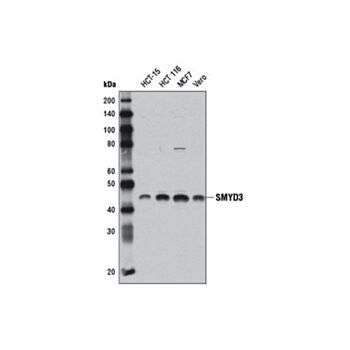
| Size | 100 µl |
| Reactivity | H Mk |
| Sensitivity | Endogenous |
| Molecular Weight (kDa) | 42 |
| Source/Isotype | Rabbit IgG |
| Application/Dilution | {Western Blotting: 1:1000} |
| Storage | Supplied in 10 mM sodium HEPES (pH 7.5), 150 mM NaCl, 100 µg/ml BSA, 50% glycerol and less than 0.02% sodium azide. Store at –20°C. Do not aliquot the antibody. |
| Specificity/Sensitivity | SMYD3 (D2Q4V) Rabbit mAb recognizes endogenous levels of total SMYD3 protein. This antibody does not cross-react with other SMYD proteins. |
| Species Reactivity | Human, Monkey |
| Source/Purification | Monoclonal antibody is produced by immunizing animals with a synthetic peptide corresponding to residues surrounding Pro357 of human SMYD3 protein. |
| Background | SET and MYND domain containing protein 3 (SMYD3) is a member of the SET domain-containing family of protein methyltransferases and is localized to both the nucleus and cytoplasm (1-3). Several histone substrates have been identified for SMYD3; however, the data is controversial. In one study, SMYD3 has been shown to methylate histone H3 Lys4 (both di- and tri-methylation) and interact with RNA polymerase II to activate transcription (1). A second study has shown that SMYD3 preferentially methylates histone H4 Lys20 and interacts with nuclear receptor corepressor complex (NCOR) to repress transcription (2). A third study has shown that SMYD3 preferentially methylates histone H4 Lys5 (mono-, di-, and tri-methylation) (3). In addition, SMYD3 has been shown to methylate the endothelial growth factor receptor 1 (VEGFR1) on Lys831 and stimulate its kinase activity (4). Regardless of the preferred protein substrates, it is clear that SMYD3 functions as an oncogene. Research studies have shown SMYD3 is highly over-expressed in liver, breast, and rectal carcinomas. Over-expression of SMYD3 in multiple cell lines enhances proliferation, adhesion, and migration, while reduced expression results in significant suppression of cell growth (1,5-10). In addition, multiple cancer cell lines express both full length SMYD3 and a cleaved form of SMYD3 lacking the N-terminal 34 amino acids, and the cleaved form shows increased methyltransferase activity toward histone H3 (11). |
| SKU | CSIG-12859S |
|---|---|
| Featured | No |
| Supplier Part Number | 12859S |
| UM | EA |
| UNSPSC | 41106509 |
| Manufacturer | Cell Signaling |
| MSDS URL | Click here |
| Temperature | -20C |
| CountryOfOrigin | United States |
| ProductLine | CSIG |
| Qty | 1 |
| MinOrderQty | 1 |
| Weight | 7.000000 |
| Lead Time | 5 |
| Hazardous | N |
| ACT Ecolabel | No |