We use cookies to make your experience better. To comply with the new e-Privacy directive, we need to ask for your consent to set the cookies. Learn more.

Cell Signaling Symmetric Di-Methyl Histone H3 (Arg8) (E1w5h) Rabbit mAb
List Price
$407.03
Your Price
$407.03
Cell Signaling Symmetric Di-Methyl Histone H3 (Arg8) (E1w5h) Rabbit mAb - CSIG (Additional S&H or Hazmat Fees May Apply)
NETA PART:
CSIG-13939S
MFG.PART:
13939S
UNSPSC:
41106509
Manufacturer:
Cell Signaling


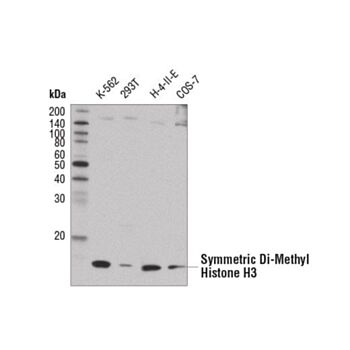
| Size | 100 µl |
| Reactivity | H M R Mk |
| Sensitivity | Endogenous |
| Molecular Weight (kDa) | 17 |
| Source/Isotype | Rabbit IgG |
| Application/Dilution | {Western Blotting: 1:1000} |
| Storage | Supplied in 10 mM sodium HEPES (pH 7.5), 150 mM NaCl, 100 µg/ml BSA, 50% glycerol and less than 0.02% sodium azide. Store at –20°C. Do not aliquot the antibody. |
| Specificity/Sensitivity | Symmetric Di-Methyl Histone H3 (Arg8) (E1W5H) Rabbit mAb recognizes endogenous levels of histone H3 protein only when symmetrically di-methylated at Arg8. This antibody may have a slight cross reactivity towards histone H3 protein when mono-methylated at Arg8. |
| Species Reactivity | Human, Mouse, Rat, Monkey |
| Source/Purification | Monoclonal antibody is produced by immunizing animals with a synthetic peptide corresponding to residues near the amino terminus of human histone H3 in which Arg8 is symmetrically di-methylated. |
| Background | The nucleosome is the primary chromatin building block and consists of DNA wrapped around an octamer made of paired histone proteins H2A, H2B, H3, and H4. Chromatin remodeling plays a critical role in the regulation of various nuclear activities, including transcription. Histone proteins are targets of post-translational modification, including acetylation, phosphorylation, ubiquitination, and methylation. Modified histone residues are recognized and bound by chromatin modifiers and the transcription machinery to regulate gene expression (1-4). Protein arginine methyltransferases (PRMTs) methylate histone proteins at arginine residues to generate mono-methylated, symmetrically di-methylated, or asymmetrically di-methylated proteins. Asymmetrically di-methylated arginine residues are found on histone H3 (Arg2, 8, 17, 26, and 42), histone H4 (Arg3), and histone H2A (Arg3) proteins. Asymmetric methylation is carried out by type 1 PRMTs, which include PRMT1, PRMT2, PRMT4/CARM1, and PRMT6. These modifications are often associated with actively transcribed genes. Symmetric di-methylation of arginine residues are found on histone H3 (Arg2 and 8), histones H4 (Arg3), and H2A (Arg3). Symmetrically di-methylated histone arginine residues are generated by type II transferases PRMT5 and PRMT7, and are often associated with transcription repression (5-9). Arginine residues can also be deiminated by a peptidyl arginine deiminase (PADI) to form the non-coded amino acid citrulline. Conversion of arginine to citrulline prevents methylation of this residue and is thought to regulate histone arginine methylation levels (10-13). |
| SKU | CSIG-13939S |
|---|---|
| Featured | No |
| Supplier Part Number | 13939S |
| UM | EA |
| UNSPSC | 41106509 |
| Manufacturer | Cell Signaling |
| MSDS URL | Click here |
| Temperature | -20C |
| CountryOfOrigin | United States |
| ProductLine | CSIG |
| Qty | 1 |
| MinOrderQty | 1 |
| Weight | 7.000000 |
| Lead Time | 5 |
| Hazardous | N |
| ACT Ecolabel | No |