We use cookies to make your experience better. To comply with the new e-Privacy directive, we need to ask for your consent to set the cookies. Learn about our cookie policy.

Cell Signaling Fabp7 (D8n3n) Rabbit mAb
List Price
$354.51
Your Price
$354.51
Cell Signaling Fabp7 (D8n3n) Rabbit mAb - CSIG (Additional S&H or Hazmat Fees May Apply)
NETA PART:
CSIG-13347S
MFG.PART:
13347S
UNSPSC:
12352200
Manufacturer:
Cell Signaling


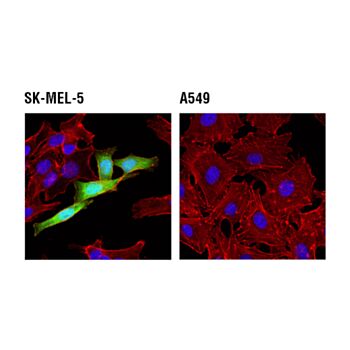
| Size | 100 µl |
| Reactivity | H R |
| Sensitivity | Endogenous |
| Molecular Weight (kDa) | 15 |
| Source/Isotype | Rabbit IgG |
| Application/Dilution | {Western Blotting: 1:1000, Immunofluorescence (Immunocytochemistry): 1:2000} |
| Storage | Supplied in 10 mm sodium HEPES (pH 7.5), 150 mm NaCl, 100 µg/mL BSA, 50% glycerol and less than 0.02% sodium azide. Store at –20°C. Do not aliquot the antibody. |
| Specificity/Sensitivity | FABP7 (D8N3N) Rabbit mAb recognizes endogenous levels of total FABP7 protein. Species cross-reactivity for IF-IC is human only. |
| Species Reactivity | Human, Rat |
| Source/Purification | Monoclonal antibody is produced by immunizing animals with a synthetic peptide corresponding to residues surrounding Val84 of human FABP7 protein. |
| Background | Fatty acid binding proteins (FABPs) bind to fatty acids and other lipids to function as cytoplasmic lipid chaperones (1). They participate in the transport of fatty acids and other lipids to various cellular pathways (2). Differential expression of FABPs is found in several types of tumors and their normal-cell counterparts (3). FABP7 is abundantly expressed in fetal brain and may be essential for development (4). Expression is required for the establishment of the radial glial fiber system, a system that is necessary for the development of cortical layers (5). Increased expression of FABP7 is associated with reduced survival in patients with glioblastoma (6), and is also found in glial cells following nerve injury (7). Investigators have found loss of FABP7 may be involved in the development and progression of breast cancer and expression of FABP7 has been shown to induce mammary differentiation and to inhibit growth of breast cancer cells (8,9). |
| SKU | CSIG-13347S |
|---|---|
| Supplier Part Number | 13347S |
| UM | EA |
| UNSPSC | 12352200 |
| Manufacturer | Cell Signaling |
| MSDS URL | Click here |
| Temperature | -20C |
| CountryOfOrigin | United States |
| ProductLine | CSIG |
| Qty | 1 |
| MinOrderQty | 1 |
| Weight | 7.000000 |
| Lead Time | 5 |
| Hazardous | N |
| Energy Star | No |
| Green | No |
| Controlled | N |