We use cookies to make your experience better. To comply with the new e-Privacy directive, we need to ask for your consent to set the cookies. Learn more.

Cell Signaling Apc1 (D1e9d) Rabbit mAb
List Price
$342.39
Your Price
$342.39
Cell Signaling Apc1 (D1e9d) Rabbit mAb - CSIG (Additional S&H or Hazmat Fees May Apply)
NETA PART:
CSIG-13329S
MFG.PART:
13329S
UNSPSC:
12352202
Manufacturer:
Cell Signaling


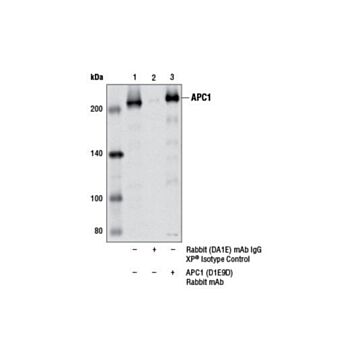
| Size | 100 µl |
| Reactivity | H Mk |
| Sensitivity | Endogenous |
| Molecular Weight (kDa) | 216 |
| Source/Isotype | Rabbit IgG |
| Application/Dilution | {Western Blotting: 1:1000, Immunoprecipitation: 1:200} |
| Storage | Supplied in 10 mM sodium HEPES (pH 7.5), 150 mM NaCl, 100 µg/ml BSA, 50% glycerol and less than 0.02% sodium azide. Store at –20°C. Do not aliquot the antibody. |
| Specificity/Sensitivity | APC1 (D1E9D) Rabbit mAb recognizes endogenous levels of total APC1 protein. |
| Species Reactivity | Human, Monkey |
| Source/Purification | Monoclonal antibody is produced by immunizing animals with a synthetic peptide corresponding to residues near the carboxy terminus of human APC1 protein. |
| Background | Eukaryotic cell proliferation depends strictly upon the E3 ubiquitin ligase activity of the anaphase promoting complex/cyclosome (APC/C), whose main function is to trigger the transition of the cell cycle from metaphase to anaphase. The APC/C complex promotes the assembly of polyubiquitin chains on substrate proteins in order to target these proteins for degradation by the 26S proteasome (1,2). The vertebrate APC/C complex consists of as many as 15 subunits, including multiple scaffold proteins, two catalytic subunits (APC2, APC11), and a number of proteins responsible for substrate recognition (3). All E3 enzymes, including APC/C, utilize ubiquitin residues activated by E1 enzymes and transferred to E2 enzymes. Research studies indicate that APC/C interacts with the E2 enzymes UBE2S and UBE2C via the RING-finger domain-containing subunit APC11 (4-6). APC/C function relies on multiple cofactors, including an APC/C coactivator formed by the cell division control protein 20 homolog (CDC20) and Cdh1/FZR1. The CDC20/Cdh1 coactivator is responsible for recognition of APC/C substrates through interaction with specific D-box and KEN-box recognition elements within these substrates (7-9).The ubiquitously expressed anaphase-promoting complex subunit 1 (APC1) is the largest subunit of the APC/C complex (10). Research studies demonstrate that APC1 undergoes extensive phosphorylation on serine and threonine residues during the mitotic phase of the eukaryotic cell cycle (11). |
| SKU | CSIG-13329S |
|---|---|
| Featured | No |
| Supplier Part Number | 13329S |
| UM | EA |
| UNSPSC | 12352202 |
| Manufacturer | Cell Signaling |
| MSDS URL | Click here |
| Temperature | -20C |
| CountryOfOrigin | United States |
| ProductLine | CSIG |
| Qty | 1 |
| MinOrderQty | 1 |
| Weight | 7.000000 |
| Lead Time | 5 |
| Hazardous | N |
| ACT Ecolabel | No |