We use cookies to make your experience better. To comply with the new e-Privacy directive, we need to ask for your consent to set the cookies. Learn more.

Cell Signaling Psmg1/Pac1 Antibody
List Price
$309.06
Your Price
$309.06
Cell Signaling Psmg1/Pac1 Antibody - CSIG (Additional S&H or Hazmat Fees May Apply)
NETA PART:
CSIG-13378S
MFG.PART:
13378S
UNSPSC:
12352202
Manufacturer:
Cell Signaling


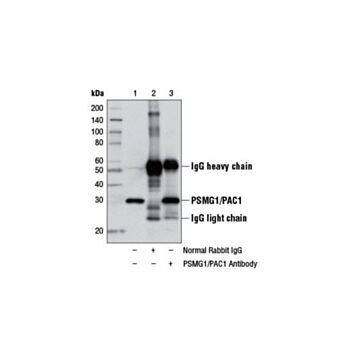
| Size | 100 µl |
| Reactivity | H Mk |
| Sensitivity | Endogenous |
| Molecular Weight (kDa) | 30 |
| Source/Isotype | Rabbit |
| Application/Dilution | {Western Blotting: 1:1000, Immunoprecipitation: 1:200} |
| Storage | Supplied in 10 mM sodium HEPES (pH 7.5), 150 mM NaCl, 100 µg/ml BSA and 50% glycerol. Store at –20°C. Do not aliquot the antibody. |
| Specificity/Sensitivity | PSMG1/PAC1 Antibody recognizes endogenous levels of total PSMG1 (PAC1) protein in human and monkey cells. This antibody weakly cross-reacts with murine and rat PSMG1 (PAC1) protein. This antibody does not cross-react with PSMG2 (PAC2) protein. |
| Species Reactivity | Human, Monkey |
| Source/Purification | Polyclonal antibodies are produced by immunizing animals with a synthetic peptide corresponding to residues near the amino terminus of human PSMG1 (PAC1) protein. Antibodies are purified by protein A and peptide affinity chromatography. |
| Background | The 26S proteasome is a highly abundant proteolytic complex involved in the degradation of ubiquitinated substrate proteins. It consists largely of two sub-complexes, the 20S catalytic core particle (CP) and the 19S/PA700 regulatory particle (RP) that can cap either end of the CP. The CP consists of two stacked heteroheptameric β-rings (β1-7) that contain three catalytic β-subunits and are flanked on either side by two heteroheptameric α-rings (α1-7). The RP includes a base and a lid, each having multiple subunits. The base, in part, is composed of a heterohexameric ring of ATPase subunits belonging to the AAA (ATPases Associated with diverse cellular Activities) family. The ATPase subunits function to unfold the substrate and open the gate formed by the α-subunits, thus exposing the unfolded substrate to the catalytic β-subunits. The lid consists of ubiquitin receptors and DUBs that function in recruitment of ubiquitinated substrates and modification of ubiquitin chain topology (1,2). Other modulators of proteasome activity, such as PA28/11S REG, can also bind to the end of the 20S CP and activate it (1,2).Proteasome assembly chaperone 1 (PSMG1, PAC1) is an evolutionarily conserved, ubiquitously expressed chaperone protein that promotes proper biogenesis of the α-ring of the 20S CP of the eukaryotic proteasome (3,4). PSMG1 (PAC1) functions in a heterodimeric complex with PSMG2 (PAC2) and was originally identified as a proteasome subunit binding partner (4). Intact PSMG1-PSMG2 heterodimers both promote heteroheptameric α-ring assembly and/or stability and prevent accumulation of non-productive α-ring dimers (4). Research studies targeting the disruption of the murine Psmg1 locus have substantiated the importance of proteasome chaperones in contributing to normal proteasome maturation and cellular homeostasis by demonstrating that loss of Psmg1/Pac1 function leads to embryonic lethality (5). |
| SKU | CSIG-13378S |
|---|---|
| Featured | No |
| Supplier Part Number | 13378S |
| UM | EA |
| UNSPSC | 12352202 |
| Manufacturer | Cell Signaling |
| MSDS URL | Click here |
| Temperature | -20C |
| CountryOfOrigin | United States |
| ProductLine | CSIG |
| Qty | 1 |
| MinOrderQty | 1 |
| Weight | 7.000000 |
| Lead Time | 5 |
| Hazardous | N |
| ACT Ecolabel | No |