We use cookies to make your experience better. To comply with the new e-Privacy directive, we need to ask for your consent to set the cookies. Learn about our cookie policy.

Cell Signaling Tri-Methyl Lysine Motif (D1l1x) Rabbit mAb
List Price
$419.15
Your Price
$419.15
Cell Signaling Tri-Methyl Lysine Motif [Tme-K] (D1l1x) Rabbit mAb - CSIG (Additional S&H or Hazmat Fees May Apply)
NETA PART:
CSIG-14680S
MFG.PART:
14680S
UNSPSC:
12352203
Manufacturer:
Cell Signaling


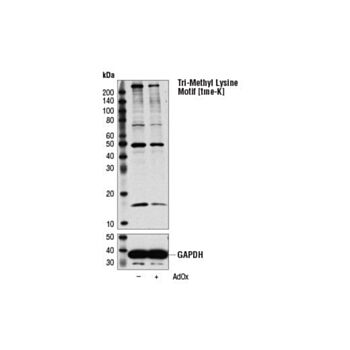
| Size | 100 µl |
| Reactivity | All |
| Sensitivity | Endogenous |
| Source/Isotype | Rabbit IgG |
| Application/Dilution | {Western Blotting: 1:1000} |
| Storage | Supplied in 10 mm sodium HEPES (pH 7.5), 150 mm NaCl, 100 µg/mL BSA, 50% glycerol. Store at –20°C. Do not aliquot the antibody. |
| Specificity/Sensitivity | Tri-Methyl Lysine Motif [tme-K] (D1L1X) Rabbit mAb recognizes endogenous levels of proteins only when tri-methylated at a lysine residue. This antibody does not cross-react with endogenous levels of proteins with mono- or di-methylated lysine or arginine residues. |
| Species Reactivity | All Species Expected |
| Source/Purification | Monoclonal antibody is produced by immunizing animals with a synthetic peptide library containing tri-methyl lysine. |
| Background | Methylation of lysine residues is a common regulatory post-translational modification (PTM) that results in the mono-, di-, or tri-methylation of lysine at ε-amine groups by protein lysine methyltransferases (PKMTs). Two PKMT groups are recognized based on structure and catalytic mechanism: class I methyltransferases or seven β strand enzymes, and SET domain-containing class V methyltransferases. Both use the methyl donor S-adenosyl-L-methionine to methylate histone and non-histone proteins. Class I methyltransferases methylate amino acids, DNA, and RNA (1,2). Six methyl-lysine-interacting protein families are distinguished based on binding domains: MBT, PHD finger, Tudor, PWWP, WD40 repeat, and chromodomains. Many of these display differential binding preferences based on lysine methylation state (3). KDM1 subfamily lysine demethylases catalyze demethylation of mono- and di-methyl lysines, while 2-oxoglutarate-dependent JmjC (KDM2-7) subfamily enzymes also modify tri-methyl lysine residues (4).Most PKMT substrates are histone proteins and transcription factors, emphasizing the importance of lysine methylation in regulating chromatin structure and gene expression. Lys9 of histone H3 is mono- or di-methylated by G9A/GLP and tri-methylated by SETDB1 to activate transcription. JHDM3A-mediated demethylation of the same residue creates mono-methyl Lys9 and inhibits gene transcription (5). Tumor suppressor p53 is regulated by methylation of at least four sites. p53-mediated transcription is repressed following mono-methylation of p53 at Lys370 by SMYD2; di-methylation at the same residue further inhibits p53 by preventing association with 53BP1. Concomitant di-methylation at Lys382 inhibits p53 ubiquitination following DNA damage. Mono-methylation at Lys382 by SET8 suppresses p53 transcriptional activity, while SET7/9 mono-methylation at Lys372 inhibits SMYD2 methylation at Lys370 and stabilizes the p53 protein. Di-methylation at Lys373 by G9A/GLP inhibits p53-mediated apoptosis and correlates with tri-methylation of histone H3 Lys9 at the p21 promoter (1,6). Overexpression of PKMTs is associated with multiple forms of human cancer, which has generated tremendous interest in targeting protein lysine methyltransferases in drug discovery research. |
| SKU | CSIG-14680S |
|---|---|
| Supplier Part Number | 14680S |
| UM | EA |
| UNSPSC | 12352203 |
| Manufacturer | Cell Signaling |
| MSDS URL | Click here |
| Temperature | -20C |
| CountryOfOrigin | United States |
| ProductLine | CSIG |
| Qty | 1 |
| MinOrderQty | 1 |
| Weight | 7.000000 |
| Lead Time | 5 |
| Hazardous | N |
| Energy Star | No |
| Green | No |
| Controlled | N |