We use cookies to make your experience better. To comply with the new e-Privacy directive, we need to ask for your consent to set the cookies. Learn about our cookie policy.

Cell Signaling Mta2 Antibody
List Price $320.17 Your Price $320.17
Cell Signaling Mta2 Antibody - CSIG (Additional S&H or Hazmat Fees May Apply)
NETA PART: CSIG-15793S
MFG.PART: 15793S
UNSPSC: 12352203
Manufacturer: Cell Signaling


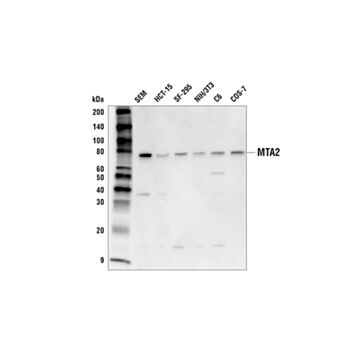
| Size | 100 µl |
| Reactivity | H M R Mk |
| Sensitivity | Endogenous |
| Molecular Weight (kDa) | 75 |
| Source/Isotype | Rabbit |
| Application/Dilution | {Western Blotting: 1:1000} |
| Storage | Supplied in 10 mm sodium HEPES (pH 7.5), 150 mm NaCl, 100 µg/mL BSA and 50% glycerol. Store at –20°C. Do not aliquot the antibody. |
| Specificity/Sensitivity | MTA2 Antibody recognizes endogenous levels of total MTA2 protein. This antibody does not cross-react with other MTA proteins. This antibody detects a 50 kDa band of unknown origin in rat cell lysates. |
| Species Reactivity | Human, Mouse, Rat, Monkey |
| Source/Purification | Polyclonal antibodies are produced by immunizing animals with a synthetic peptide corresponding to residues surrounding Pro602 of human MTA2 protein. Antibodies are purified by peptide affinity chromatography. |
| Background | MTA2 is a component of the NuRD deacetylase complex, which is recruited by MBD3 and modulates the enzymatic activity of the histone deacetylase core (1,2). MTA2 is highly related to MTA1, but both proteins exist in biologically distinct complexes, with MTA2 being associated with complexes containing Sin3a and CHD4 (3) MTA2 has been shown to bind ERα and repress its activity and contributes to estradiol- and tamoxifen-resistant breast cancers (4). Indeed, the MTA proteins are critical regulators of many biological functions in both cancer and non-cancer settings (5,6). MTA2 upregulation has been reported in a multitude of cancers, including hepatocellular carcinomas, colorectal cancers, gastric cancers, and esophageal cancers (7-10). MTA2 has also been described in B cell development, where it interacts with Aiolos and Ikaros to control target genes (11). |
| SKU | CSIG-15793S |
|---|---|
| Supplier Part Number | 15793S |
| UM | EA |
| UNSPSC | 12352203 |
| Manufacturer | Cell Signaling |
| MSDS URL | Click here |
| Temperature | -20C |
| CountryOfOrigin | United States |
| ProductLine | CSIG |
| Qty | 1 |
| MinOrderQty | 1 |
| Weight | 7.000000 |
| Lead Time | 5 |
| Hazardous | N |
| Energy Star | No |
| Green | No |
| Controlled | N |