We use cookies to make your experience better. To comply with the new e-Privacy directive, we need to ask for your consent to set the cookies. Learn about our cookie policy.

Cell Signaling Phospho-Relb (Ser552) (D41b9) Xp Rabbit mAb (BSA And Azide Free)
List Price $906.98 Your Price $906.98
Cell Signaling Phospho-Relb (Ser552) (D41b9) Xp Rabbit mAb (BSA And Azide Free) - CSIG (Additional S&H or Hazmat Fees May Apply)
NETA PART: CSIG-17616SF
MFG.PART: 17616SF
UNSPSC: 12352203
Manufacturer: Cell Signaling


| Size | 100 µg |
| Reactivity | H M |
| Sensitivity | Endogenous |
| Molecular Weight (kDa) | 70 |
| Source/Isotype | Rabbit IgG |
| Application/Dilution | {} |
| Storage | Supplied in 1X PBS, BSA and Azide Free.For standard formulation of this product see product #5025 |
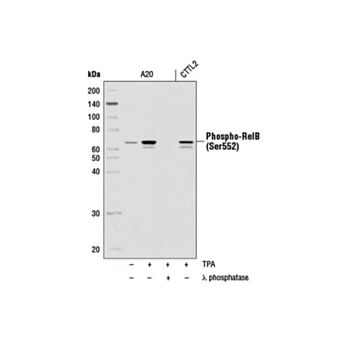
| Specificity/Sensitivity | Phospho-RelB (Ser552) (D41B9) XP® Rabbit mAb (BSA and Azide Free) detects endogenous levels of RelB only when phosphorylated at Ser552. |
| Species Reactivity | Human, Mouse |
| Source/Purification | Monoclonal antibody is produced by immunizing animals with a synthetic phosphopeptide corresponding to residues surrounding Ser552 of mouse RelB protein. |
| Background | Transcription factors of the nuclear factor κB (NF-κB)/Rel family play a pivotal role in inflammatory and immune responses (1,2). There are five family members in mammals: RelA, c-Rel, RelB, NF-κB1 (p105/p50), and NF-κB2 (p100/p52). Both p105 and p100 are proteolytically processed by the proteasome to produce p50 and p52, respectively. Rel proteins bind p50 and p52 to form dimeric complexes that bind DNA and regulate transcription. In unstimulated cells, NF-κB is sequestered in the cytoplasm by IκB inhibitory proteins (3-5). NF-κB-activating agents can induce the phosphorylation of IκB proteins, targeting them for rapid degradation through the ubiquitin-proteasome pathway and releasing NF-κB to enter the nucleus where it regulates gene expression (6-8). NIK and IKKα (IKK1) regulate the phosphorylation and processing of NF-κB2 (p100) to produce p52, which translocates to the nucleus (9-11).RelB, which is generally activated by non-canonical signaling, forms heterodimers with either p50 or p52 NF-κB subunits to regulate transcription (12,13). RelB null mice are significantly impaired in inflammatory responses and hematopoietic differentiation (14,15). Phosphorlyation at Thr84 and Ser552 results in proteosomal degradation (16). |
| SKU | CSIG-17616SF |
|---|---|
| Supplier Part Number | 17616SF |
| UM | EA |
| UNSPSC | 12352203 |
| Manufacturer | Cell Signaling |
| MSDS URL | Click here |
| Temperature | -20C |
| CountryOfOrigin | United States |
| ProductLine | CSIG |
| Qty | 1 |
| MinOrderQty | 1 |
| Weight | 7.000000 |
| Lead Time | 5 |
| Hazardous | N |
| Energy Star | No |
| Green | No |
| Controlled | N |