We use cookies to make your experience better. To comply with the new e-Privacy directive, we need to ask for your consent to set the cookies. Learn about our cookie policy.

Cell Signaling Bcl-W (31h4) Rabbit mAb
List Price
$354.51
Your Price
$354.51
Cell Signaling Bcl-W (31h4) Rabbit mAb - CSIG (Additional S&H or Hazmat Fees May Apply)
NETA PART:
CSIG-2724S
MFG.PART:
2724S
UNSPSC:
12352203
Manufacturer:
Cell Signaling


| Size | 100 µl |
| Reactivity | H M R |
| Sensitivity | Endogenous |
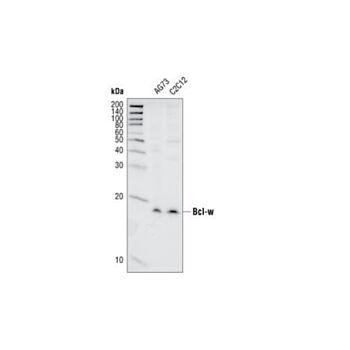
| Molecular Weight (kDa) | 18 |
| Source/Isotype | Rabbit IgG |
| Application/Dilution | {Western Blotting: 1:1000} |
| Storage | Supplied in 10 mm sodium HEPES (pH 7.5), 150 mm NaCl, 100 µg/mL BSA, 50% glycerol and less than 0.02% sodium azide. Store at –20°C. Do not aliquot the antibody. |
| Specificity/Sensitivity | Bcl-W (31H4) Rabbit mAb detects endogenous levels of total Bcl-W protein. |
| Species Reactivity | Human, Mouse, Rat |
| Source/Purification | Monoclonal antibody is produced by immunizing animals with a synthetic peptide corresponding to residues surrounding alanine 39 of Bcl-W. |
| Background | The Bcl-2 family consists of a number of evolutionarily conserved proteins containing Bcl-2 homology domains (BH) that regulate apoptosis through control of mitochondrial membrane permeability and release of cytochrome c (1-3). Four BH domains have been identified (BH1-4) that mediate protein interactions. The family can be separated into three groups based upon function and sequence homology: pro-survival members include Bcl-2, Bcl-xL, Mcl-1, A1 and Bcl-W; pro-apoptotic proteins include Bax, Bak and Bok; and "BH3 only" proteins Bad, Bik, Bid, Puma, Bim, Bmf, Noxa and Hrk. Interactions between death-promoting and death-suppressing Bcl-2 family members has led to a rheostat model in which the ratio of pro-apoptotic and anti-apoptotic proteins controls cell fate (4). Thus, pro-survival members exert their behavior by binding to and antagonizing death-promoting members. In general, the "BH3-only members" can bind to and antagonize the pro-survival proteins leading to increased apoptosis (5). While some redundancy of this system likely exists, tissue specificity, transcriptional and post-translational regulation of many of these family members can account for distinct physiological roles.The pro-survival protein Bcl-W was originally identified in a PCR-based strategy aimed at discovering novel Bcl-2 family members and was found to be expressed in cells of myeloid origin, as well as many other tissues (6,7). Most tissues from bcl-W knockout mice were unaffected, but male mice did show defects in seminiferous tubule organization and spermatogenogenesis (8,9). |
| SKU | CSIG-2724S |
|---|---|
| Supplier Part Number | 2724S |
| UM | EA |
| UNSPSC | 12352203 |
| Manufacturer | Cell Signaling |
| MSDS URL | Click here |
| Temperature | -20C |
| CountryOfOrigin | United States |
| ProductLine | CSIG |
| Qty | 1 |
| MinOrderQty | 1 |
| Weight | 7.000000 |
| Lead Time | 5 |
| Hazardous | N |
| Energy Star | No |
| Green | No |
| Controlled | N |