We use cookies to make your experience better. To comply with the new e-Privacy directive, we need to ask for your consent to set the cookies. Learn more.

Cell Signaling Pme-1 (8a6-F8) Mouse mAb
List Price
$339.36
Your Price
$339.36
Cell Signaling Pme-1 (8a6-F8) Mouse mAb - CSIG (Additional S&H or Hazmat Fees May Apply)
NETA PART:
CSIG-29135S
MFG.PART:
29135S
UNSPSC:
12352203
Manufacturer:
Cell Signaling


| Size | 100 µl |
| Reactivity | H M R |
| Sensitivity | Endogenous |
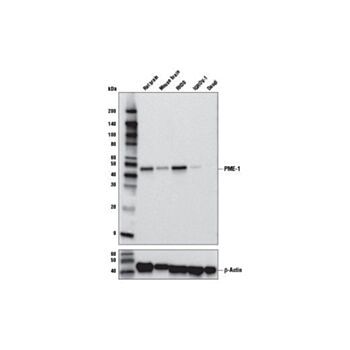
| Molecular Weight (kDa) | 42 |
| Source/Isotype | Mouse IgG1 |
| Application/Dilution | {Western Blotting: 1:1000} |
| Storage | Supplied in 10 mM sodium HEPES (pH 7.5), 150 mM NaCl, 100 µg/ml BSA, 50% glycerol and less than 0.02% sodium azide. Store at –20°C. Do not aliquot the antibody. |
| Specificity/Sensitivity | PME-1 (8A6-F8) Mouse mAb recognizes endogenous levels of total PME-1 protein. |
| Species Reactivity | Human, Mouse, Rat |
| Source/Purification | Monoclonal antibody is produced by immunizing animals with recombinant full-length mouse PME-1 protein. |
| Background | Protein phosphatase methylesterase 1 (PME-1) is an evolutionarily conserved enzyme that demethylates phosphatases (1). Post-translational modification (PTMs) of proteins is a cellular mechanism that increases the functional diversity of the proteome. Several forms of PTMs exist, including methylation and phosphorylation, the covalent addition of a methyl or phosphate group, respectively, to specific amino acids within a protein. In addition to enzymes that catalyze the addition of methyl groups or phosphates to proteins, specific enzymes that remove PTMs exist to provide an additional level of cellular regulation; methyl and phosphate PTMs are removed by methylesterases and phosphatases, respectively. Phosphoprotein phosphatase 2a (PP2A) is an essential serine/threonine phosphatase that, as part of various signal transduction pathways, regulates many fundamental cellular processes, including DNA replication, transcription, translation, metabolism, cell cycle progression, cell division, apoptosis, and development (2-4). PP2A function is regulated, in part, by phospho- and methyl modification of its catalytic subunit. PP2A is methylated at the carboxyl group of the C-terminal Leucine 309 residue by leucine carboxyl methyltransferase (LCMT). Methylation of PP2A alters its cellular localization and its ability to interact with its regulatory subunits and substrates (5-8). PP2A is demethylated by PME-1 (9,10). PME-1 KO mice are post-natal lethal, and KO tissue exhibit altered PP2A activity and phospho-proteomic profile, consistent with a critical role PME-1 plays in regulating PP2A function (11). Dysregulated PP2A activity is linked to several diseases, including certain cancers and neurodegenerative diseases like Alzheimer’s disease, suggesting that PME-1 could be the target of therapeutic intervention (12-14). |
| SKU | CSIG-29135S |
|---|---|
| Featured | No |
| Supplier Part Number | 29135S |
| UM | EA |
| UNSPSC | 12352203 |
| Manufacturer | Cell Signaling |
| MSDS URL | Click here |
| Temperature | -20C |
| CountryOfOrigin | United States |
| ProductLine | CSIG |
| Qty | 1 |
| MinOrderQty | 1 |
| Weight | 7.000000 |
| Lead Time | 5 |
| Hazardous | N |
| ACT Ecolabel | No |