We use cookies to make your experience better. To comply with the new e-Privacy directive, we need to ask for your consent to set the cookies. Learn about our cookie policy.

Cell Signaling Transthyretin (D8t4q) Rabbit mAb
List Price
$354.51
Your Price
$354.51
Cell Signaling Transthyretin (D8t4q) Rabbit mAb - CSIG (Additional S&H or Hazmat Fees May Apply)
NETA PART:
CSIG-29872S
MFG.PART:
29872S
UNSPSC:
12352203
Manufacturer:
Cell Signaling


| Size | 100 µl |
| Reactivity | H |
| Sensitivity | Endogenous |
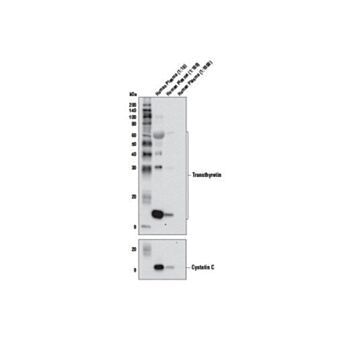
| Molecular Weight (kDa) | 15, 30, 45, 60 |
| Source/Isotype | Rabbit IgG |
| Application/Dilution | {Western Blotting: 1:1000} |
| Storage | Supplied in 10 mm sodium HEPES (pH 7.5), 150 mm NaCl, 100 µg/mL BSA, 50% glycerol and less than 0.02% sodium azide. Store at –20°C. Do not aliquot the antibody. |
| Specificity/Sensitivity | Transthyretin (D8T4Q) Rabbit mAb recognizes endogenous levels of total Transthyretin protein in its monomeric, dimeric, trimeric, and tetrameric forms. |
| Species Reactivity | Human |
| Source/Purification | Monoclonal antibody is produced by immunizing animals with a synthetic peptide corresponding to residues surrounding Pro106 of human Transthyretin protein. |
| Background | Transthyretin (TTR) is a highly conserved homotetremric protein that is synthesized in the liver and choroid plexus of the brain. TTR was originally discovered as a protein found in human plasma and cerebrospinal fluid (CSF) (1). TTR transports thyroid hormones (TH) and retinol by binding to retinol-binding protein (2). Although TTR is synthesized in the liver and choroid plexus, TTR is detected in blood plasma and cerebrospinal fluid migrating as monomers, dimers, and tetramers. Beyond its function as a carrier protein of TH and retinol in plasma and CSF, several additional TTR functions have been described, including proteolytic cleavage of specific substrates like apolipoprotein, neuropeptide Y (NPY), and APP (3, 4, 5). These neuronal substrates suggest a functional role for TTR in the central nervous system. Consistent with a CNS function, TTR null mice exhibit memory impairments and altered sensorimotor behavior (6, 7). TTR may also be linked to neurodegenerative disease: TTR levels in Alzheimer’s disease (AD) patients are negatively correlated with disease progression, and a protective role for TTR, at least in AD mouse models, has been described (8, 9). TTR itself may play a more direct role in disease as gain-of-function mutations in TTR cause the protein to misfold and aggregate into amyloid fibrils, contributing to autosomal dominant hereditary amyloidosis in diseases such as familial amyloid polyneuropathy, familial amyloid cardiomyopathy, and familial leptomeningeal amyloidosis (10). |
| SKU | CSIG-29872S |
|---|---|
| Supplier Part Number | 29872S |
| UM | EA |
| UNSPSC | 12352203 |
| Manufacturer | Cell Signaling |
| MSDS URL | Click here |
| Temperature | -20C |
| CountryOfOrigin | United States |
| ProductLine | CSIG |
| Qty | 1 |
| MinOrderQty | 1 |
| Weight | 7.000000 |
| Lead Time | 5 |
| Hazardous | N |
| Energy Star | No |
| Green | No |
| Controlled | N |