We use cookies to make your experience better. To comply with the new e-Privacy directive, we need to ask for your consent to set the cookies. Learn about our cookie policy.

Cell Signaling Phospho-Caveolin-1 (Tyr14) Antibody
List Price $149.48 Your Price $149.48
Cell Signaling Phospho-Caveolin-1 (Tyr14) Antibody - CSIG (Additional S&H or Hazmat Fees May Apply)
NETA PART: CSIG-3251T
MFG.PART: 3251T
UNSPSC: 12352203
Manufacturer: Cell Signaling


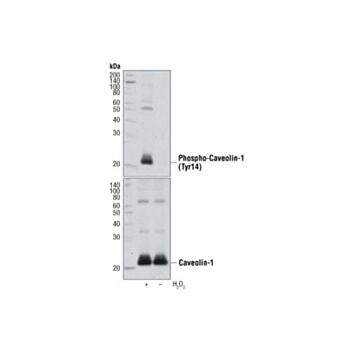
| Size | 20 µl |
| Reactivity | H M R Mk |
| Sensitivity | Endogenous |
| Molecular Weight (kDa) | 23, 25 |
| Source/Isotype | Rabbit |
| Application/Dilution | {Western Blotting: 1:1000} |
| Storage | Supplied in 10 mm sodium HEPES (pH 7.5), 150 mm NaCl, 100 µg/mL BSA and 50% glycerol. Store at –20°C. Do not aliquot the antibody. |
| Specificity/Sensitivity | Phospho-Caveolin-1 (Tyr14) Antibody detects endogenous levels of caveolin-1 only when phosphorylated at tyrosine 14. The antibody does not cross-react with paxillin, caveolin-2, -3 or caveolin-1beta, the short isoform of caveolin-1. |
| Species Reactivity | Human, Mouse, Rat, Monkey |
| Source/Purification | Polyclonal antibodies are produced by immunizing animals with a synthetic phosphopeptide corresponding to residues surrounding Tyr14 of human caveolin-1. Antibodies are purified by protein A and peptide affinity chromatography. |
| Background | The 21-24 kDa integral proteins, caveolins, are the principal structural components of the cholesterol/sphingolipid-enriched plasma membrane microdomain caveolae. Three members of the caveolin family (caveolin-1, -2, and -3) have been identified with different tissue distributions. Caveolins form hetero- and homo-oligomers that interact with cholesterol and other lipids (1). Caveolins are involved in diverse biological functions, including vesicular trafficking, cholesterol homeostasis, cell adhesion, and apoptosis, and are also implicated in neurodegenerative disease (2). Caveolins interact with multiple signaling molecules, such as Gα subunit, tyrosine kinase receptors, PKCs, Src family tyrosine kinases, and eNOS (1,2). It is believed that caveolins serve as scaffolding proteins for the integration of signal transduction. Phosphorylation at Tyr14 is essential for caveolin association with SH2 or PTB domain-containing adaptor proteins, such as GRB7 (3-5). Phosphorylation at Ser80 regulates caveolin binding to the ER membrane and entry into the secretory pathway (6). |
| SKU | CSIG-3251T |
|---|---|
| Supplier Part Number | 3251T |
| UM | EA |
| UNSPSC | 12352203 |
| Manufacturer | Cell Signaling |
| MSDS URL | Click here |
| Temperature | -20C |
| CountryOfOrigin | United States |
| ProductLine | CSIG |
| Qty | 1 |
| MinOrderQty | 1 |
| Weight | 7.000000 |
| Lead Time | 5 |
| Hazardous | N |
| Energy Star | No |
| Green | No |
| Controlled | N |