We use cookies to make your experience better. To comply with the new e-Privacy directive, we need to ask for your consent to set the cookies. Learn about our cookie policy.

Cell Signaling Phospho-Fgf Receptor (Tyr653/654) (55h2) Mouse mAb
List Price
$478.74
Your Price
$478.74
Cell Signaling Phospho-Fgf Receptor (Tyr653/654) (55h2) Mouse mAb - CSIG (Additional S&H or Hazmat Fees May Apply)
NETA PART:
CSIG-3476S
MFG.PART:
3476S
UNSPSC:
12352203
Manufacturer:
Cell Signaling


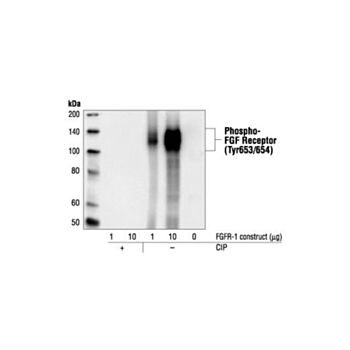
| Size | 100 µl |
| Reactivity | H |
| Sensitivity | Endogenous |
| Molecular Weight (kDa) | 120, 145 |
| Source/Isotype | Mouse IgG2b |
| Application/Dilution | {Western Blotting: 1:1000} |
| Storage | Supplied in 10 mm sodium HEPES (pH 7.5), 150 mm NaCl, 100 µg/mL BSA, 50% glycerol and less than 0.02% sodium azide. Store at –20°C. Do not aliquot the antibody. |
| Specificity/Sensitivity | Phospho-FGF Receptor (Tyr653/654) (55H2) Mouse mAb detects endogenous levels of FGF receptors only when phosphorylated at tyrosines 653/654. This antibody detects phosphorylated FGF Receptors 2 and 4 when expressed exogenously. Based on sequence comparisons, reactivity with FGF Receptor 3 is possible but has not been experimentally confirmed. The antibody also cross-reacts slightly with activated PDGF and insulin/IGF-I receptors. |
| Species Reactivity | Human |
| Source/Purification | Monoclonal antibody is produced by immunizing animals with a synthetic phosphopeptide corresponding to residues surrounding Tyr653/654 of human FGF receptor-1. The corresponding sequence is identical in FGF receptor-2, -3 and -4. |
| Background | Fibroblast growth factors (FGFs) produce mitogenic and angiogenic effects in target cells by signaling through cell surface receptor tyrosine kinases. There are four members of the FGF receptor family: FGFR1 (flg), FGFR2 (bek, KGFR), FGFR3, and FGFR4. Each receptor contains an extracellular ligand-binding domain, a transmembrane domain, and a cytoplasmic kinase domain (1). Following ligand binding and dimerization, the receptors are phosphorylated at specific tyrosine residues (2). Seven tyrosine residues in the cytoplasmic tail of FGFR1 can be phosphorylated: Tyr463, 583, 585, 653, 654, 730, and 766. Tyr653 and Tyr654 are important for catalytic activity of activated FGFR and are essential for signaling (3). The other phosphorylated tyrosine residues may provide docking sites for downstream signaling components, such as Crk and PLCγ (4,5). |
| SKU | CSIG-3476S |
|---|---|
| Supplier Part Number | 3476S |
| UM | EA |
| UNSPSC | 12352203 |
| Manufacturer | Cell Signaling |
| MSDS URL | Click here |
| Temperature | -20C |
| CountryOfOrigin | United States |
| ProductLine | CSIG |
| Qty | 1 |
| MinOrderQty | 1 |
| Weight | 7.000000 |
| Lead Time | 5 |
| Hazardous | N |
| Energy Star | No |
| Green | No |
| Controlled | N |