We use cookies to make your experience better. To comply with the new e-Privacy directive, we need to ask for your consent to set the cookies. Learn more.

Cell Signaling Phospho-Hsp90alpha (Thr5/7) Antibody
List Price
$360.57
Your Price
$360.57
Cell Signaling Phospho-Hsp90alpha (Thr5/7) Antibody - CSIG (Additional S&H or Hazmat Fees May Apply)
NETA PART:
CSIG-3488S
MFG.PART:
3488S
UNSPSC:
12352203
Manufacturer:
Cell Signaling


| Size | 100 µl |
| Reactivity | H M R Mk |
| Sensitivity | Endogenous |
| Molecular Weight (kDa) | 90 |
| Source/Isotype | Rabbit |
| Application/Dilution | {Western Blotting: 1:1000} |
| Storage | Supplied in 10 mM sodium HEPES (pH 7.5), 150 mM NaCl, 100 µg/ml BSA and 50% glycerol. Store at –20°C. Do not aliquot the antibody. |
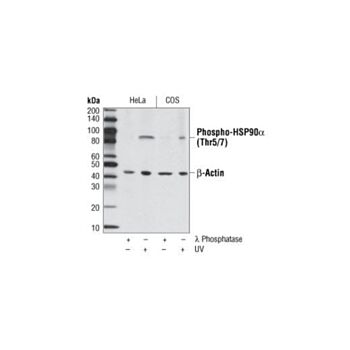
| Specificity/Sensitivity | Phospho-HSP90α (Thr5/7) Antibody detects endogenous levels of HSP90α only when phosphorylated at Thr5/7. |
| Species Reactivity | Human, Mouse, Rat, Monkey |
| Source/Purification | Polyclonal antibodies are produced by immunizing animals with a synthetic phosphopeptide corresponding to residues surrounding Thr5/7 of human HSP90α. Antibodies are purified by protein A and peptide affinity chromatography. |
| Background | HSP70 and HSP90 are molecular chaperones expressed constitutively under normal conditions to maintain protein homeostasis and are induced upon environmental stress (1). Both HSP70 and HSP90 are able to interact with unfolded proteins to prevent irreversible aggregation and catalyze the refolding of their substrates in an ATP- and co-chaperone-dependent manner (1). HSP70 has a broad range of substrates including newly synthesized and denatured proteins, while HSP90 tends to have a more limited subset of substrates, most of which are signaling molecules. HSP70 and HSP90 often function collaboratively in a multi-chaperone system, which requires a minimal set of co-chaperones: HSP40, Hop, and p23 (2,3). The co-chaperones either regulate the intrinsic ATPase activity of the chaperones or recruit chaperones to specific substrates or subcellular compartments (1,4). When the ubiquitin ligase CHIP associates with the HSP70/HSP90 complex as a cofactor, the unfolded substrates are subjected to degradation by the proteasome (4). The biological functions of HSP70/HSP90 extend beyond their chaperone activity. They are essential for the maturation and inactivation of nuclear hormones and other signaling molecules (1,3). They also play a role in vesicle formation and protein trafficking (2).Phospho-HSP90α (Thr5/7) Antibody is directed against the HSP90α threonine phosphorylation site at Thr5/7 that was identified at Cell Signaling Technology (CST) using PhosphoScan®, CSTs MS/MS platform for phosphorylation site discovery. Phosphorylation of HSP90α at Thr5/7 was previously observed by the human double-stranded DNA-activated protein kinase (5). Please visit PhosphoSitePlus®, CSTs modification site knowledgebase, at www.phosphosite.org for more information. |
| SKU | CSIG-3488S |
|---|---|
| Featured | No |
| Supplier Part Number | 3488S |
| UM | EA |
| UNSPSC | 12352203 |
| Manufacturer | Cell Signaling |
| MSDS URL | Click here |
| Temperature | -20C |
| CountryOfOrigin | United States |
| ProductLine | CSIG |
| Qty | 1 |
| MinOrderQty | 1 |
| Weight | 7.000000 |
| Lead Time | 5 |
| Hazardous | N |
| ACT Ecolabel | No |