We use cookies to make your experience better. To comply with the new e-Privacy directive, we need to ask for your consent to set the cookies. Learn about our cookie policy.

Cell Signaling Uchl1 Antibody
List Price
$320.17
Your Price
$320.17
Cell Signaling Uchl1 Antibody - CSIG (Additional S&H or Hazmat Fees May Apply)
NETA PART:
CSIG-3524S
MFG.PART:
3524S
UNSPSC:
12352203
Manufacturer:
Cell Signaling


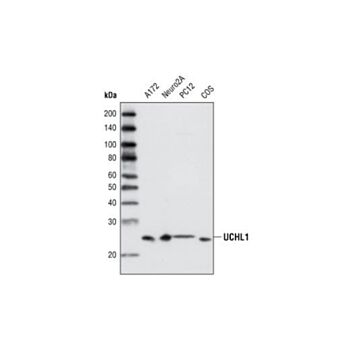
| Size | 100 µl |
| Reactivity | H M R Mk |
| Sensitivity | Endogenous |
| Molecular Weight (kDa) | 27 |
| Source/Isotype | Rabbit |
| Application/Dilution | {Western Blotting: 1:1000} |
| Storage | Supplied in 10 mm sodium HEPES (pH 7.5), 150 mm NaCl, 100 µg/mL BSA and 50% glycerol. Store at –20°C. Do not aliquot the antibody. |
| Specificity/Sensitivity | UCHL1 Antibody detects endogenous levels of total UCHL1 protein. |
| Species Reactivity | Human, Mouse, Rat, Monkey |
| Source/Purification | Polyclonal antibodies are produced by immunizing animals with a synthetic peptide corresponding to residues surrounding Asp110 of human UCHL1 protein. Antibodies are purified by peptide affinity chromatography. |
| Background | Protein ubiquitination and deubiquitination are reversible processes catalyzed by ubiquitinating enzymes (UBEs) and deubiquitinating enzymes (DUBs) (1,2). DUBs are categorized into 5 subfamilies: USP, UCH, OTU, MJD, and JAMM. UCHL1, UCHL3, UCHL5/UCH37, and BRCA-1-associated protein-1 (BAP1) belong to the UCH family of DUBs, which all posses a conserved catalytic domain (UCH domain) of about 230 amino acids. UCHL5 and BAP1 have unique extended C-terminal tails. UCHL1 is abundantly expressed in neuronal tissues and testes, while UCHL3 expression is more widely distributed (3,4). Although UCHL1 and UCHL3 are the most closely related UCH family members with about 53% identity, their biochemical properties differ in that UCHL1 binds monoubiquitin and UCHL3 shows dual specificity toward both ubiquitin (Ub) and NEDD8, a Ub-like molecule. In particular, UCHL3 functions as a Ub hydrolase involved in the processing of both Ub precursors and ubiquitinated substrates, generating free monomeric Ub. This is accomplished through the ability of UCHL3 to recognize and hydrolyze isopeptide bonds at the C-terminal glycine of either Ub or NEDD8 (5-7). Recent functional studies have identified UCH-L3 as a critical regulator of adipogenesis through its ability to promote IGF-IR and insulin receptor signaling (8). Furthermore, UCHL3 has been shown to promote deubiquitination, recycling, and cell surface expression of the epithelial sodium channel (9). |
| SKU | CSIG-3524S |
|---|---|
| Supplier Part Number | 3524S |
| UM | EA |
| UNSPSC | 12352203 |
| Manufacturer | Cell Signaling |
| MSDS URL | Click here |
| Temperature | -20C |
| CountryOfOrigin | United States |
| ProductLine | CSIG |
| Qty | 1 |
| MinOrderQty | 1 |
| Weight | 7.000000 |
| Lead Time | 5 |
| Hazardous | N |
| Energy Star | No |
| Green | No |
| Controlled | N |