We use cookies to make your experience better. To comply with the new e-Privacy directive, we need to ask for your consent to set the cookies. Learn about our cookie policy.

Cell Signaling Phospho-Cd79a (Tyr210) Antibody
List Price
$365.62
Your Price
$365.62
Cell Signaling Phospho-Cd79a (Tyr210) Antibody - CSIG (Additional S&H or Hazmat Fees May Apply)
NETA PART:
CSIG-35718S
MFG.PART:
35718S
UNSPSC:
12352203
Manufacturer:
Cell Signaling


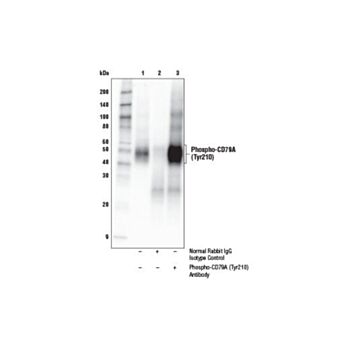
| Size | 100 µl |
| Reactivity | H |
| Sensitivity | Endogenous |
| Molecular Weight (kDa) | 50 |
| Source/Isotype | Rabbit |
| Application/Dilution | {Western Blotting: 1:1000, Immunoprecipitation: 1:50} |
| Storage | Supplied in 10 mm sodium HEPES (pH 7.5), 150 mm NaCl, 100 µg/mL BSA and 50% glycerol. Store at –20°C. Do not aliquot the antibody. |
| Specificity/Sensitivity | Phospho-CD79A (Tyr210) Antibody recognizes endogenous levels of CD79A protein only when phosphorylated at Tyr210. |
| Species Reactivity | Human |
| Source/Purification | Polyclonal antibodies are produced by immunizing animals with a synthetic phosphopeptide corresponding to residues surrounding Tyr210 of human CD79A protein. Antibodies are purified by peptide affinity chromatography. |
| Background | Antigen receptors found on the surface of B cells contain a heterodimeric signaling component composed of CD79A and CD79B, also known as Ig α and Ig β, respectively (1,2). Presence of this receptor complex is essential for B cell development and function (3). Together these two proteins and the associated B cell receptor (BCR) initiate intracellular signaling following antigen binding (4,5). An immunoreceptor tyrosine-based activation motif (ITAM) found in the CD79A intracellular region appears to be important for its function (6). Antigen binding precedes formation of the CD79A and CD79B heterodimer and subsequent activation of receptor associated kinases (7). Research has shown that CD79A is a marker for B-lineage lymphoblastic leukemia (8). Additionally, investigators have found that mutations in the CD79A (MB1) gene are associated with abnormally low levels of functional B cell receptors in some cases of chronic B cell lymphocytic leukemia (9).Tyrosine 210 is an evolutionarily conserved non-ITAM tyrosine residue that lies within the cytoplasmic domain of CD79A/Ig-alpha. Research studies have shown that ligation of the B cell receptor (BCR) induces phosphorylation of tyrosine 210, which facilitates both the recruitment of BLNK to the BCR signaling complex and the activation of downstream Syk-dependent signaling (10,11). Collectively, these molecular events drive B cell activation and proliferation (12). |
| SKU | CSIG-35718S |
|---|---|
| Supplier Part Number | 35718S |
| UM | EA |
| UNSPSC | 12352203 |
| Manufacturer | Cell Signaling |
| MSDS URL | Click here |
| Temperature | -20C |
| CountryOfOrigin | United States |
| ProductLine | CSIG |
| Qty | 1 |
| MinOrderQty | 1 |
| Weight | 7.000000 |
| Lead Time | 5 |
| Hazardous | N |
| Energy Star | No |
| Green | No |
| Controlled | N |