We use cookies to make your experience better. To comply with the new e-Privacy directive, we need to ask for your consent to set the cookies. Learn more.

Cell Signaling Rhoe (4) Mouse mAb
List Price
$339.36
Your Price
$339.36
Cell Signaling Rhoe (4) Mouse mAb - CSIG (Additional S&H or Hazmat Fees May Apply)
NETA PART:
CSIG-3664S
MFG.PART:
3664S
UNSPSC:
12352203
Manufacturer:
Cell Signaling


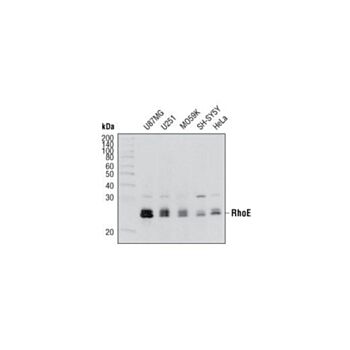
| Size | 100 µl |
| Reactivity | H Mk |
| Sensitivity | Endogenous |
| Molecular Weight (kDa) | 29 |
| Source/Isotype | Mouse IgG1 |
| Application/Dilution | {Western Blotting: 1:1000} |
| Storage | Supplied in 10 mM sodium HEPES (pH 7.5), 150 mM NaCl, 100 µg/ml BSA, 50% glycerol and less than 0.02% sodium azide. Store at –20°C. Do not aliquot the antibody. |
| Specificity/Sensitivity | RhoE (4) Mouse mAb detects endogenous levels of total RhoE protein. |
| Species Reactivity | Human, Monkey |
| Source/Purification | Monoclonal antibody is produced by immunizing animals with full length recombinant human RhoE. |
| Background | Rho family small GTPases act as molecular switches that regulate processes such as cell migration, adhesion, proliferation and differentiation. Typically, they are activated by guanine nucleotide exchange factors (GEFs), which catalyze the exchange of bound GDP for GTP, and are inhibited by GTPase activating proteins (GAPs), which catalyze the hydrolysis of GTP to GDP (1). Rnd1, Rnd2 and RhoE/Rnd3 comprise the evolutionarily divergent Rnd family of Rho-type small GTPases, which lack GTPase activity and therefore remain in a GTP-bound state (2, reviewed in 3). RhoE/Rnd3 activity leads to a decrease in stress fibers and increased cell migration, at least in part through regulation of the Rho-dependent kinase ROCK1 (4). Activity of RhoE/Rnd3 itself is regulated by ROCK1, which phosphorylates RhoE/Rnd3 at Ser11, enhancing its activity (5). RhoE/Rnd3 has been implicated in inhibition of DNA-damage induced apoptosis (6) and cell cycle arrest (7). In keratinocytes, RhoE/Rnd3 regulates differentiation through its effects on both proliferation and adhesion (8). |
| SKU | CSIG-3664S |
|---|---|
| Featured | No |
| Supplier Part Number | 3664S |
| UM | EA |
| UNSPSC | 12352203 |
| Manufacturer | Cell Signaling |
| MSDS URL | Click here |
| Temperature | -20C |
| CountryOfOrigin | United States |
| ProductLine | CSIG |
| Qty | 1 |
| MinOrderQty | 1 |
| Weight | 7.000000 |
| Lead Time | 5 |
| Hazardous | N |
| ACT Ecolabel | No |