We use cookies to make your experience better. To comply with the new e-Privacy directive, we need to ask for your consent to set the cookies. Learn more.

Cell Signaling Jip4/Spag9 (D72f4) Xp Rabbit mAb
List Price
$374.71
Your Price
$374.71
Cell Signaling Jip4/Spag9 (D72f4) Xp Rabbit mAb - CSIG (Additional S&H or Hazmat Fees May Apply)
NETA PART:
CSIG-5519S
MFG.PART:
5519S
UNSPSC:
12352203
Manufacturer:
Cell Signaling


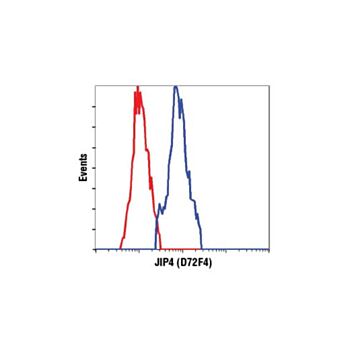
| Size | 100 µl |
| Reactivity | H M R Mk |
| Sensitivity | Endogenous |
| Molecular Weight (kDa) | 190 |
| Source/Isotype | Rabbit IgG |
| Application/Dilution | {Western Blotting: 1:1000, Immunoprecipitation: 1:50, Immunohistochemistry (Paraffin): 1:50, Immunofluorescence (Immunocytochemistry): 1:50, Flow Cytometry (Fixed/Permeabilized): 1:50} |
| Storage | Supplied in 10 mM sodium HEPES (pH 7.5), 150 mM NaCl, 100 µg/ml BSA, 50% glycerol and less than 0.02% sodium azide. Store at –20°C. Do not aliquot the antibody. |
| Specificity/Sensitivity | JIP4/SPAG9 (D72F4) XP® Rabbit mAb recognizes endogenous levels of total JIP4 protein. This antibody will detect known splice variants of JIP4 (SPAG9, JLP) but is not predicted to cross-react with other JIP family members. |
| Species Reactivity | Human, Mouse, Rat, Monkey |
| Source/Purification | Monoclonal antibody is produced by immunizing animals with a synthetic peptide corresponding to a region surrounding Leu237 of human JIP4 protein. |
| Background | JNK-Interacting Proteins (JIPs), as their name implies, coordinate c-Jun N-terminal Kinase (JNK) signaling by acting as scaffolds for components of the JNK signaling cascade (1). JIPs localize and promote JNK activation in response to stress by amalgamating and co-localizing upstream kinases and downstream effectors in the stress-kinase pathway analogous to the mechanism by which AKAPs orchestrate PKA signaling. JIPs bind to an array of MAPKs and other signaling proteins, including the mixed-lineage kinases, MKK7, p38α MAPK, JNK1-3, Max, Myc, NF-κB, LRRK2, and others (1-4).There are four known JIPs, JIP1-4, of which JIP1 and JIP2 share extensive sequence homology and domain structure. JIP1 and JIP2 are mainly expressed in neurons, testis and in β pancreatic cells, where they have been implicated in cellular responses to metabolic stress, the development of diabetes, and post-traumatic brain damage (5-7). Although architecturally distinct from JIP1 and JIP2, JIP3 and JIP4 share some overlapping functions and are more broadly expressed. JIP4, encoded by the SPAG9 (sperm-associated antigen-9) gene, is a homooligomer that binds to and coordinates the activation of numerous components of the stress-activated kinase cascade including MEK4, MEKK3, p38α MAPK, and JNK1-3 (1,3). However, unlike the other JIP members, JIP4 does not appear to activate JNK directly, instead favoring stimulation of p38 MAPK signaling events in response to cellular stress (3,8).In addition to mediating stress responses, JIP4 (or its splice variant, JLP) has also been shown to interact with ARF6 and PIKfyve, thus regulating microtubule-based endosomal trafficking (9,10). There are extensive reports indicating that JIP4 is phosphorylated in response to stress (UV damage etc.) but it is unclear what effect, if any, this has on its function, localization, or binding properties (11-14). |
| SKU | CSIG-5519S |
|---|---|
| Featured | No |
| Supplier Part Number | 5519S |
| UM | EA |
| UNSPSC | 12352203 |
| Manufacturer | Cell Signaling |
| MSDS URL | Click here |
| Temperature | -20C |
| CountryOfOrigin | United States |
| ProductLine | CSIG |
| Qty | 1 |
| MinOrderQty | 1 |
| Weight | 7.000000 |
| Lead Time | 5 |
| Hazardous | N |
| ACT Ecolabel | No |