We use cookies to make your experience better. To comply with the new e-Privacy directive, we need to ask for your consent to set the cookies. Learn about our cookie policy.

Cell Signaling Glucocorticoid Receptor (D6h2l) Xp Rabbit mAb (Biotinylated)
List Price $469.65 Your Price $469.65
Cell Signaling Glucocorticoid Receptor (D6h2l) Xp Rabbit mAb (Biotinylated) - CSIG (Additional S&H or Hazmat Fees May Apply)
NETA PART: CSIG-58122S
MFG.PART: 58122S
UNSPSC: 12352203
Manufacturer: Cell Signaling


| Size | 100 µl |
| Reactivity | H M R Mk |
| Sensitivity | Endogenous |
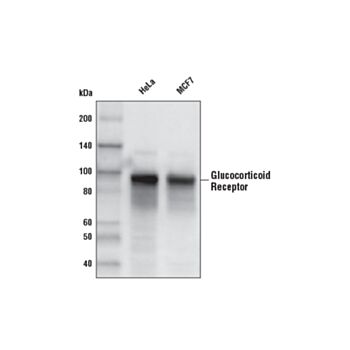
| Molecular Weight (kDa) | 94, 91 |
| Source/Isotype | Rabbit IgG |
| Application/Dilution | {Western Blotting: 1:1000} |
| Storage | Supplied in 136 mm NaCl, 2.6 mm KCI, 12 mm sodium phosphate (pH 7.4) dibasic, 2 mg/mL BSA, and 50% glycerol. Store at –20°C. Do not aliquot the antibody. |
| Specificity/Sensitivity | Glucocorticoid Receptor (D6H2L) XP® Rabbit mAb (Biotinylated) recognizes endogenous levels of total GR protein. This antibody reacts with GR-α and GR-β but does not cross-react with mineralocorticoid receptor. |
| Species Reactivity | Human, Mouse, Rat, Monkey |
| Source/Purification | Monoclonal antibody is produced by immunizing animals with a recombinant protein specific to the amino terminus of human GR protein. |
| Background | Glucocorticoid hormones control cellular proliferation, inflammation, and metabolism through their association with the glucocorticoid receptor (GR)/NR3C1, a member of the nuclear hormone receptor superfamily of transcription factors (1). GR is composed of several conserved structural elements, including a carboxy-terminal ligand-binding domain (which also contains residues critical for receptor dimerization and hormone-dependent gene transactivation), a neighboring hinge region containing nuclear localization signals, a central zinc-finger-containing DNA-binding domain, and an amino-terminal variable region that participates in ligand-independent gene transcription. In the absence of hormone, a significant population of GR is localized to the cytoplasm in an inactive form via its association with regulatory chaperone proteins, such as HSP90, HSP70, and FKBP52. On hormone binding, GR is released from the chaperone complex and translocates to the nucleus as a dimer to associate with specific DNA sequences termed glucocorticoid response elements (GREs), thereby enhancing or repressing transcription of specific target genes (2). It was demonstrated that GR-mediated transcriptional activation is modulated by phosphorylation (3-5). Although GR can be basally phosphorylated in the absence of hormone, it becomes hyperphosphorylated upon binding receptor agonists. It has been suggested that hormone-dependent phosphorylation of GR may determine target promoter specificity, cofactor interaction, strength and duration of receptor signaling, receptor stability, and receptor subcellular localization (3). |
| SKU | CSIG-58122S |
|---|---|
| Supplier Part Number | 58122S |
| UM | EA |
| UNSPSC | 12352203 |
| Manufacturer | Cell Signaling |
| MSDS URL | Click here |
| Temperature | -20C |
| CountryOfOrigin | United States |
| ProductLine | CSIG |
| Qty | 1 |
| MinOrderQty | 1 |
| Weight | 7.000000 |
| Lead Time | 5 |
| Hazardous | N |
| Energy Star | No |
| Green | No |
| Controlled | N |