We use cookies to make your experience better. To comply with the new e-Privacy directive, we need to ask for your consent to set the cookies. Learn more.

Cell Signaling C9orf72 Antibody
List Price
$381.78
Your Price
$381.78
Cell Signaling C9orf72 Antibody - CSIG (Additional S&H or Hazmat Fees May Apply)
NETA PART:
CSIG-64196S
MFG.PART:
64196S
UNSPSC:
12352203
Manufacturer:
Cell Signaling


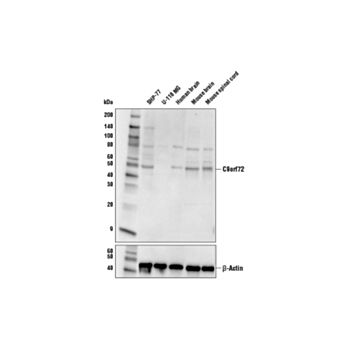
| Size | 100 µl |
| Reactivity | H M R |
| Sensitivity | Endogenous |
| Molecular Weight (kDa) | 49 |
| Source/Isotype | Rabbit |
| Application/Dilution | {Western Blotting: 1:1000} |
| Storage | Supplied in 10 mM sodium HEPES (pH 7.5), 150 mM NaCl, 100 µg/ml BSA and 50% glycerol. Store at –20°C. Do not aliquot the antibody. |
| Specificity/Sensitivity | C9orf72 Antibody recognizes endogenous levels of total C9orf72 protein. |
| Species Reactivity | Human, Mouse, Rat |
| Source/Purification | Polyclonal antibodies are produced by immunizing animals with a synthetic peptide corresponding to residues surrounding Ala202 of human C9orf72 protein. Antibodies are purified by protein A and peptide affinity chromatography. |
| Background | The expansion of hexanucleotide GGGGCC repeats in the C9orf72 gene causes chromosome 9p-linked neurodegenerative diseases amyotrophic lateral sclerosis (ALS) and frontotemporal dementia (FTD) (1,2). The specific mechanism by which of these repeats contributes to disease etiology is currently an active area of investigation (3). Several gain of function mechanisms have been proposed. These mechanisms include toxicity from C9orf72 RNA containing the hexanucleotide repeats (4) and toxicity generated from dipeptide repeat proteins produced by repeat-associated non-ATG translation (5). In addition to gain of function mechanisms, the genetic hexanucleotide repeat expansions may cause a loss of function of the C9orf72 protein. C9orf72 contains a predicted DENN (differentially expressed in normal and neoplastic cells) domain that typically functions as guanine exchange factors for Rab GTPases, proteins that play key regulatory roles in membrane trafficking (6). Consistent with C9orf72 normally functioning in membrane trafficking, biochemical and genetic studies revealed that C9orf72 forms a protein complex with Sim-Magenis chromosome region 8 (SMCR8) and WD repeat-containing protein 41 (WDR41) to regulate the autophagy-lysosomal pathway (7), suggesting that C9orf72-dependent alterations in the autophagy-lysosomal pathway might contribute to ALS/FTD pathology. |
| SKU | CSIG-64196S |
|---|---|
| Featured | No |
| Supplier Part Number | 64196S |
| UM | EA |
| UNSPSC | 12352203 |
| Manufacturer | Cell Signaling |
| MSDS URL | Click here |
| Temperature | -20C |
| CountryOfOrigin | United States |
| ProductLine | CSIG |
| Qty | 1 |
| MinOrderQty | 1 |
| Weight | 7.000000 |
| Lead Time | 5 |
| Hazardous | N |
| ACT Ecolabel | No |