We use cookies to make your experience better. To comply with the new e-Privacy directive, we need to ask for your consent to set the cookies. Learn about our cookie policy.

Cell Signaling Asct2 (D7c12) Rabbit mAb
List Price $420.16 Your Price $420.16
Cell Signaling Asct2 (D7c12) Rabbit mAb - CSIG (Additional S&H or Hazmat Fees May Apply)
NETA PART: CSIG-8057S
MFG.PART: 8057S
UNSPSC: 12352203
Manufacturer: Cell Signaling


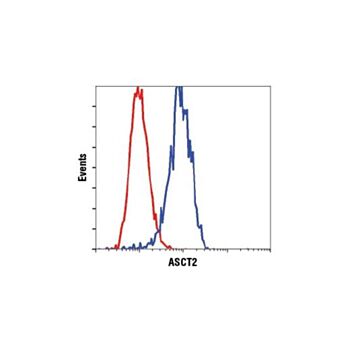
| Size | 100 µl |
| Reactivity | H Mk |
| Sensitivity | Endogenous |
| Molecular Weight (kDa) | 49, 75 |
| Source/Isotype | Rabbit |
| Application/Dilution | {Western Blotting: 1:1000, Immunoprecipitation: 1:50, Immunohistochemistry (Paraffin): 1:200 - 1:800, Immunofluorescence (Immunocytochemistry): 1:400 - 1:1600, Flow Cytometry (Fixed/Permeabilized): 1:200 - 1:800} |
| Storage | Supplied in 10 mm sodium HEPES (pH 7.5), 150 mm NaCl, 100 µg/mL BSA, 50% glycerol and less than 0.02% sodium azide. Store at –20°C. Do not aliquot the antibody.For a carrier free (BSA and azide free) version of this product see product #69974. |
| Specificity/Sensitivity | ASCT2 (D7C12) Rabbit mAb recognizes endogenous levels of total ASCT2 protein. |
| Species Reactivity | Human, Monkey |
| Source/Purification | Monoclonal antibody is produced by immunizing animals with a synthetic peptide corresponding to residues near the amino terminus of human ASCT2 protein. |
| Background | Sodium-dependent neutral amino acid transporter type 2 (ASCT2 or SLC1A5) is a neutral amino acid transporter that regulates the uptake of essential amino acids in conjunction with the SLC7A5 bilateral transporter (1,2). ASCT2 appears to be the major glutamine transporter in hepatoma cells and is thought to provide essential amino acids needed for tumor growth (3). Additional evidence suggests that ASCT2 plays a role in activating mTORC1 signaling and is required to suppress autophagy (4,5). Cell surface ASCT2 serves as a receptor for several mammalian interference retroviruses associated with cases of infectious immunodeficiency; variation in a small region of an extracellular loop (ECL2) may be responsible for species-specific differences in receptor function (6). |
| SKU | CSIG-8057S |
|---|---|
| Supplier Part Number | 8057S |
| UM | EA |
| UNSPSC | 12352203 |
| Manufacturer | Cell Signaling |
| MSDS URL | Click here |
| Temperature | -20C |
| CountryOfOrigin | United States |
| ProductLine | CSIG |
| Qty | 1 |
| MinOrderQty | 1 |
| Weight | 7.000000 |
| Lead Time | 5 |
| Hazardous | N |
| Energy Star | No |
| Green | No |
| Controlled | N |