We use cookies to make your experience better. To comply with the new e-Privacy directive, we need to ask for your consent to set the cookies. Learn more.

Cell Signaling Phospho-Plcgamma1 (Ser1248) (D25a9) Rabbit mAb
List Price
$405.01
Your Price
$405.01
Cell Signaling Phospho-Plcgamma1 (Ser1248) (D25a9) Rabbit mAb - CSIG (Additional S&H or Hazmat Fees May Apply)
NETA PART:
CSIG-8713S
MFG.PART:
8713S
UNSPSC:
12352203
Manufacturer:
Cell Signaling


| Size | 100 µl |
| Reactivity | H M Mk |
| Sensitivity | Endogenous |
| Molecular Weight (kDa) | 150 |
| Source/Isotype | Rabbit IgG |
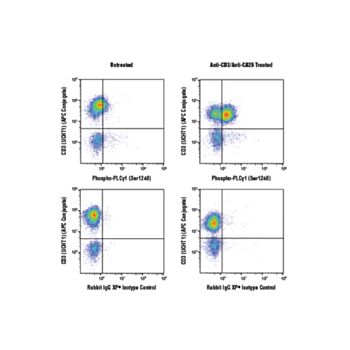
| Application/Dilution | {Western Blotting: 1:1000, Immunoprecipitation: 1:50, Immunohistochemistry (Paraffin): 1:100 - 1:400, Immunofluorescence (Immunocytochemistry): 1:100 - 1:200, Flow Cytometry (Fixed/Permeabilized): 1:800} |
| Storage | Supplied in 10 mM sodium HEPES (pH 7.5), 150 mM NaCl, 100 µg/ml BSA, 50% glycerol and less than 0.02% sodium azide. Store at –20°C. Do not aliquot the antibody. |
| Specificity/Sensitivity | Phospho-PLCγ1 (Ser1248) (D25A9) Rabbit mAb recognizes endogenous levels of PLCγ1 protein only when phosphorylated at Ser1248. |
| Species Reactivity | Human, Mouse, Monkey |
| Source/Purification | Monoclonal antibody is produced by immunizing animals with a synthetic peptide corresponding to residues surrounding Ser1248 of human PLCγ1 protein. |
| Background | Phosphoinositide-specific phospholipase C (PLC) plays a significant role in transmembrane signaling. In response to extracellular stimuli, such as hormones, growth factors, and neurotransmitters, PLC hydrolyzes phosphatidylinositol 4,5-bisphosphate (PIP2) to generate two secondary messengers: inositol 1,4,5-triphosphate (IP3) and diacylglycerol (DAG) (1). At least four families of PLCs have been identified: PLCβ, PLCγ, PLCδ, and PLCε. Phosphorylation is one of the key mechanisms that regulate the activity of PLC. PLCγ is activated by both receptor and non-receptor tyrosine kinases (2). PLCγ forms a complex with EGF and PDGF receptors, which leads to the phosphorylation of PLCγ at Tyr771, 783, and 1248 (3). Phosphorylation by Syk at Tyr783 activates the enzymatic activity of PLCγ1 (4). PLCγ2 is engaged in antigen-dependent signaling in B cells and collagen-dependent signaling in platelets. Phosphorylation by Btk or Lck at Tyr753, 759, 1197, and 1217 is correlated with PLCγ2 activity (5,6).Two mammalian PLCγ isoforms (γ1 and γ2) have been cloned and characterized (7,8). Like other PLC-family members, PLCγ1 and PLCγ2 contain calcium-binding (EF-hand, C2) and lipid-interacting (PH, EF-hand) domains necessary for their enzymatic activity and substrate recognition. Uniquely, PLCγ isoforms have additional, conserved SH2 and SH3 domains critical for their functions as signaling molecules and scaffolding proteins. Upon growth factor stimulation, PLCγ1 is recruited (via SH2 domains) to phosphotyrosine residues within the cytoplasmic tail of many RTKs where it serves as a substrate for the RTK and provides docking sites for additional proteins involved in RTK signaling (4-6,9-12). PLCγ1 and γ2 can also be activated downstream of receptors lacking intrinsic tyrosine kinase activity. This has been reported downstream of multiple G protein-coupled receptors and the T cell receptor in which tyrosine kinases of the Src, Syk, and Tec families serve to bind, phosphorylate, and activate PLCγ (reviewed in 13-15). Phosphorylation at tyrosine residues by both receptor and non-receptor tyrosine kinases results in robust activation of PLCγ1 activity, leading to generation of second messengers. In response to agonists, PLCγ1 is phosphorylated on Tyr783, Tyr711, and Tyr1253 (Tyr753, Tyr759, and Tyr1217 in PLCγ2) resulting in robust PI-4,5-P2 hydrolysis (4-6,9-12). Interestingly recent evidence suggests a role for tyrosine kinase-independent regulation of PLCγ in some systems. For example, in response to EGF, proline-rich regions of Akt interact with the SH3 domain of PLCγ1 resulting in association of the two enzymes, phosphorylation of PLCγ1 at Ser1248, and enhanced cellular motility (16). This finding demonstrates that PLCγ1 can function as a "scaffold" between RTKs and Akt, thereby establishing a mechanism by which the Akt signaling pathway cross-talks with tyrosine kinases. However, the mechanism and functional significance of phosphorylation at Ser1248 remains to be fully clarified, as it has also been shown that PKA-mediated phosphorylation at this site is inhibitory to PLCγ1 tyrosine phosphorylation and phospholipase activity in CD3-treated Jurkat cells (17), suggesting that Ser1248 may be an allosteric regulator of PLCγ1 activity. |
| SKU | CSIG-8713S |
|---|---|
| Featured | No |
| Supplier Part Number | 8713S |
| UM | EA |
| UNSPSC | 12352203 |
| Manufacturer | Cell Signaling |
| MSDS URL | Click here |
| Temperature | -20C |
| CountryOfOrigin | United States |
| ProductLine | CSIG |
| Qty | 1 |
| MinOrderQty | 1 |
| Weight | 7.000000 |
| Lead Time | 5 |
| Hazardous | N |
| ACT Ecolabel | No |