We use cookies to make your experience better. To comply with the new e-Privacy directive, we need to ask for your consent to set the cookies. Learn more.

Cell Signaling Phospho-Bap1 (Ser592) Antibody
List Price
$360.57
Your Price
$360.57
Cell Signaling Phospho-Bap1 (Ser592) Antibody - CSIG (Additional S&H or Hazmat Fees May Apply)
NETA PART:
CSIG-9373S
MFG.PART:
9373S
UNSPSC:
12352203
Manufacturer:
Cell Signaling


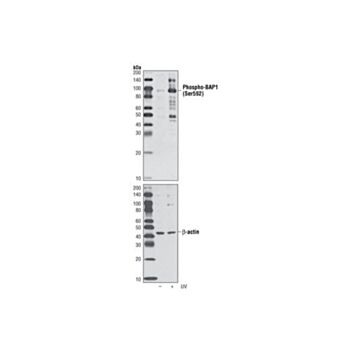
| Size | 100 µl |
| Reactivity | H |
| Sensitivity | Endogenous |
| Molecular Weight (kDa) | 95 |
| Source/Isotype | Rabbit |
| Application/Dilution | {Western Blotting: 1:1000, Immunoprecipitation: 1:50} |
| Storage | Supplied in 10 mM sodium HEPES (pH 7.5), 150 mM NaCl, 100 µg/ml BSA and 50% glycerol. Store at –20°C. Do not aliquot the antibody. |
| Specificity/Sensitivity | Phospho-BAP1 (Ser592) Antibody detects endogenous levels of BAP1 only when phosphorylated at Ser592. |
| Species Reactivity | Human |
| Source/Purification | Polyclonal antibodies are produced by immunizing animals with a synthetic phosphopeptide corresponding to residues surrounding Ser592 of human BAP1. |
| Background | BAP1 (BRCA1-Associated Protein 1) was originally identified as a BRCA1 associated, nuclear localized ubiquitin hydrolase that suppresses cell growth (1). The protein belongs to the UCH family of deubiquitinases, with a UCH domain in its N-terminal segment and a BRCA1 interaction domain as well as a nuclear localization signal in its C-terminal segment (1). Frequent gene locus rearrangement, deletion and null mutation of BAP1 have been found in lung and breast cancers (1,2). Mutation analysis in vivo in cancer cell line survival and in animal tumorigenesis indicate that both the deubiquitinase activity and the nuclear localization signal are required for BAP1 function as a tumor suppressor (3). BAP1 does not have direct deubiquitination activity towards the autoubiquitinyled BRCA1/BARD1 E3 complex (4), but its interaction with BARD1 inhibits BRCA1/BARD1 E3 activity by interfering with the compex dimerization process (5). In addition to its interaction with BRCA1/BARD1, BAP1 has also been shown to interact with and deubiquitinylate HCF-1, thereby controlling its stability (6).Phosphorylation of Ser592 on BAP1 was identified at Cell Signaling Technology (CST) using PhosphoScan®, CSTs LC-MS/MS platform for phosphorylation site discovery (7). |
| SKU | CSIG-9373S |
|---|---|
| Featured | No |
| Supplier Part Number | 9373S |
| UM | EA |
| UNSPSC | 12352203 |
| Manufacturer | Cell Signaling |
| MSDS URL | Click here |
| Temperature | -20C |
| CountryOfOrigin | United States |
| ProductLine | CSIG |
| Qty | 1 |
| MinOrderQty | 1 |
| Weight | 7.000000 |
| Lead Time | 5 |
| Hazardous | N |
| ACT Ecolabel | No |