We use cookies to make your experience better. To comply with the new e-Privacy directive, we need to ask for your consent to set the cookies. Learn about our cookie policy.

Cell Signaling Phospho-Threonine-Proline Mouse mAb (P-Thr-Pro-101)
List Price $411.07 Your Price $411.07
Cell Signaling Phospho-Threonine-Proline Mouse mAb (P-Thr-Pro-101) - CSIG (Additional S&H or Hazmat Fees May Apply)
NETA PART: CSIG-9391S
MFG.PART: 9391S
UNSPSC: 12352203
Manufacturer: Cell Signaling


| Size | 100 µl |
| Reactivity | All |
| Sensitivity | Endogenous |
| Source/Isotype | Mouse IgM |
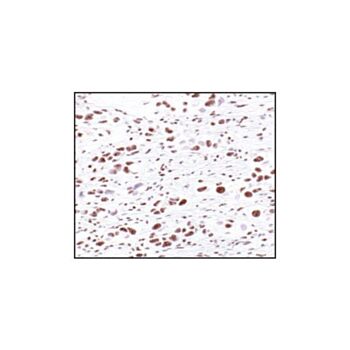
| Application/Dilution | {Western Blotting: 1:5000, Immunohistochemistry (Paraffin): 1:400, Peptide ELISA (DELFIA): 1:1000} |
| Storage | Supplied in 10 mm sodium HEPES (pH 7.5), 150 mm NaCl, 100 µg/mL BSA, 50% glycerol and less than 0.02% sodium azide. Store at –20°C. Do not aliquot the antibody. |
| Specificity/Sensitivity | Phospho-Threonine-Proline Mouse mAb (P-Thr-Pro-101) detects phospho-threonine only when followed by proline. It reacts with proteins and peptides phosphorylated at the Thr-Pro motif in an otherwise highly context-independent fashion. The antibody is phospho-specific, but does not recognize phospho-threonine in the absence of an adjacent proline. The antibody does not react with phospho-tyrosine but does react with some phospho-serine peptides containing the phospho-serine-proline motif (e.g., phospho-Elk-1). (U.S. Patent Nos.: 6,441,140; 6,982,318; 7,259,022; 7,344,714; U.S.S.N. 11,484,485; and all foreign equivalents.) |
| Species Reactivity | All Species Expected |
| Source/Purification | Monoclonal antibody is produced by immunizing animals with synthetic phospho-threonine-proline-containing peptides. This antibody is a mouse IgM clone and can be recognized by anti-mouse Ig (whole molecule) secondary antibody. |
| Background | The MAPK and CDK families of serine/threonine protein kinases play important roles in cell signaling and cell cycle control. These kinases phosphorylate threonine or serine followed by a proline residue (1-6). To facilitate the study and discovery of new MAPK and CDK substrates, Cell Signaling Technology has developed antibodies that bind to phospho-threonine or phospho-serine followed by proline.As determined by ELISA using a wide variety of phospho-Thr-Pro peptides, Phospho-Threonine-Proline Monoclonal Antibody (P-Thr-Pro-101) recognizes the phospho-Thr-Pro motif in a highly context-independent fashion. It also interacts with a broad range of phospho-Thr-Pro-containing proteins as determined by western analysis of nocodazole-treated Jurkat cell extracts resolved on 2-D gels. |
| SKU | CSIG-9391S |
|---|---|
| Supplier Part Number | 9391S |
| UM | EA |
| UNSPSC | 12352203 |
| Manufacturer | Cell Signaling |
| MSDS URL | Click here |
| Temperature | -20C |
| CountryOfOrigin | United States |
| ProductLine | CSIG |
| Qty | 1 |
| MinOrderQty | 1 |
| Weight | 7.000000 |
| Lead Time | 5 |
| Hazardous | N |
| Energy Star | No |
| Green | No |
| Controlled | N |