We use cookies to make your experience better. To comply with the new e-Privacy directive, we need to ask for your consent to set the cookies. Learn more.

Cell Signaling C-Myc Antibody
List Price
$353.50
Your Price
$353.50
Cell Signaling C-Myc Antibody - CSIG (Additional S&H or Hazmat Fees May Apply)
NETA PART:
CSIG-9402S
MFG.PART:
9402S
UNSPSC:
12352203
Manufacturer:
Cell Signaling


| Size | 100 µl |
| Reactivity | H M R |
| Sensitivity | Endogenous |
| Molecular Weight (kDa) | 57 to 70 |
| Source/Isotype | Rabbit |
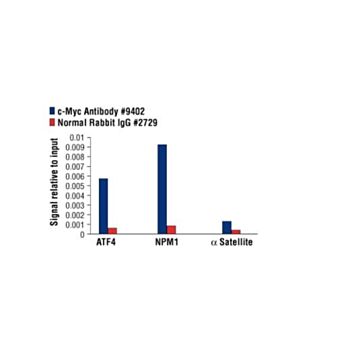
| Application/Dilution | {Western Blotting: 1:1000, Simple Western™: 1:10 - 1:50, Immunoprecipitation: 1:50, Chromatin IP: 1:50} |
| Storage | Supplied in 10 mM sodium HEPES (pH 7.5), 150 mM NaCl, 100 µg/ml BSA and 50% glycerol. Store at –20°C. Do not aliquot the antibody. |
| Specificity/Sensitivity | c-Myc Antibody detects endogenous levels of total c-Myc protein. This antibody is not recommended for detection of Myc-tagged fusion proteins (use Cell Signaling Technology cat. #2276 or #2278). |
| Species Reactivity | Human, Mouse, Rat |
| Source/Purification | Polyclonal antibodies are produced by immunizing animals with a synthetic peptide corresponding to amino-terminal residues of c-Myc. Antibodies are purified by protein A and peptide affinity chromatography. |
| Background | Members of the Myc/Max/Mad network function as transcriptional regulators with roles in various aspects of cell behavior, including proliferation, differentiation, and apoptosis (1). These proteins share a common basic-helix-loop-helix leucine zipper (bHLH-ZIP) motif required for dimerization and DNA-binding. Max was originally discovered based on its ability to associate with c-Myc and found to be required for the ability of Myc to bind DNA and activate transcription (2). Subsequently, Max has been viewed as a central component of the transcriptional network, forming homodimers as well as heterodimers with other members of the Myc and Mad families (1). The association between Max and either Myc or Mad can have opposing effects on transcriptional regulation and cell behavior (1). The Mad family consists of four related proteins; Mad1, Mad2 (Mxi1), Mad3, and Mad4, and the more distantly related members of the bHLH-ZIP family, Mnt and Mga. Like Myc, the Mad proteins are tightly regulated with short half-lives. In general, Mad family members interfere with Myc-mediated processes, such as proliferation, transformation, and prevention of apoptosis by inhibiting transcription (3,4). |
| SKU | CSIG-9402S |
|---|---|
| Featured | No |
| Supplier Part Number | 9402S |
| UM | EA |
| UNSPSC | 12352203 |
| Manufacturer | Cell Signaling |
| MSDS URL | Click here |
| Temperature | -20C |
| CountryOfOrigin | United States |
| ProductLine | CSIG |
| Qty | 1 |
| MinOrderQty | 1 |
| Weight | 7.000000 |
| Lead Time | 5 |
| Hazardous | N |
| ACT Ecolabel | No |