We use cookies to make your experience better. To comply with the new e-Privacy directive, we need to ask for your consent to set the cookies. Learn about our cookie policy.

Cell Signaling Asymmetric Dimethyl-Smarcc1/Baf155 (Arg1064) (D8i3u) Rabbit mAb
List Price $486.82 Your Price $486.82
Cell Signaling Asymmetric Dimethyl-Smarcc1/Baf155 (Arg1064) (D8i3u) Rabbit mAb - CSIG (Additional S&H or Hazmat Fees May Apply)
NETA PART: CSIG-94962S
MFG.PART: 94962S
UNSPSC: 12352203
Manufacturer: Cell Signaling


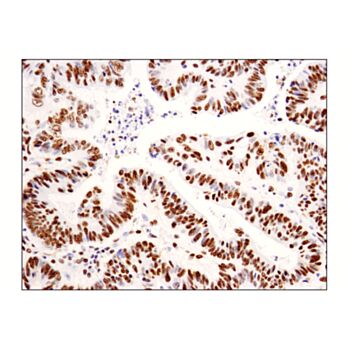
| Size | 100 µl |
| Reactivity | H M R Mk |
| Sensitivity | Endogenous |
| Molecular Weight (kDa) | 155 |
| Source/Isotype | Rabbit IgG |
| Application/Dilution | {Western Blotting: 1:1000, Immunoprecipitation: 1:50, Immunohistochemistry (Paraffin): 1:800} |
| Storage | Supplied in 10 mm sodium HEPES (pH 7.5), 150 mm NaCl, 100 µg/mL BSA, 50% glycerol and less than 0.02% sodium azide. Store at –20°C. Do not aliquot the antibody. |
| Specificity/Sensitivity | Asymmetric Dimethyl-SMARCC1/BAF155 (Arg1064) (D8I3U) Rabbit mAb recognizes endogenous levels of SMARCC1/BAF155 protein when asymmetrically dimethylated at Arg1064. This antibody does not cross-react with SMARCC1/BAF155 that is symmetrically dimethylated at Arg1064, but does show some cross-reactivity with monomethyl Arg1064. |
| Species Reactivity | Human, Mouse, Rat, Monkey |
| Source/Purification | Monoclonal antibody is produced by immunizing animals with a synthetic asymmetric dimethylpeptide corresponding to residues surrounding Arg1064 of human SMARCC1/BAF155 protein. |
| Background | ATP-dependent chromatin remodeling complexes play an essential role in the regulation of nuclear processes such as transcription and DNA replication and repair (1,2). The SWI/SNF chromatin remodeling complex consists of more than 10 subunits and contains a single molecule of either BRM or BRG1 as the ATPase catalytic subunit. The activity of the ATPase subunit disrupts histone-DNA contacts and changes the accessibility of crucial regulatory elements to the chromatin. The additional core and accessory subunits play a scaffolding role to maintain stability and provide surfaces for interaction with various transcription factors and chromatin (2-5). The interactions between SWI/SNF subunits and transcription factors, such as nuclear receptors, p53, Rb, BRCA1, and MyoD, facilitate recruitment of the complex to target genes for regulation of gene activation, cell growth, cell cycle, and differentiation processes (1,6-9).Asymmetric dimethyation of SMARCC1/BAF155 by CARM1 was found to be associated with genes upregulated by c-Myc and breast cancer progression. Furthermore, asymmetric dimethylated SMARCC1/BAF155 was found to be associated with chromatin independent of SWI/SNF ATPases Brg1 and BRM, suggesting a subcomplex capable of affecting chromatin state (10). Indeed, unmethylated SMARCC1/BAF155 seems to play a role in development as it more closely associates with Brg1 during development, which reduces pluripotency (11). |
| SKU | CSIG-94962S |
|---|---|
| Supplier Part Number | 94962S |
| UM | EA |
| UNSPSC | 12352203 |
| Manufacturer | Cell Signaling |
| MSDS URL | Click here |
| Temperature | -20C |
| CountryOfOrigin | United States |
| ProductLine | CSIG |
| Qty | 1 |
| MinOrderQty | 1 |
| Weight | 7.000000 |
| Lead Time | 5 |
| Hazardous | N |
| Energy Star | No |
| Green | No |
| Controlled | N |