We use cookies to make your experience better. To comply with the new e-Privacy directive, we need to ask for your consent to set the cookies. Learn about our cookie policy.

Cell Signaling Itpk1 Antibody
List Price $320.17 Your Price $320.17
Cell Signaling Itpk1 Antibody - CSIG (Additional S&H or Hazmat Fees May Apply)
NETA PART: CSIG-96006S
MFG.PART: 96006S
UNSPSC: 12352203
Manufacturer: Cell Signaling


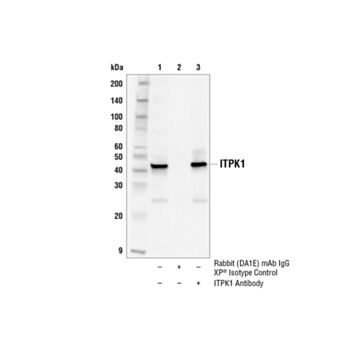
| Size | 100 µl |
| Reactivity | H M R |
| Sensitivity | Endogenous |
| Molecular Weight (kDa) | 46 |
| Source/Isotype | Rabbit |
| Application/Dilution | {Western Blotting: 1:1000, Immunoprecipitation: 1:50} |
| Storage | Supplied in 10 mm sodium HEPES (pH 7.5), 150 mm NaCl, 100 µg/mL BSA and 50% glycerol. Store at –20°C. Do not aliquot the antibody. |
| Specificity/Sensitivity | ITPK1 Antibody recognizes endogenous levels of total ITPK1 protein. |
| Species Reactivity | Human, Mouse, Rat |
| Source/Purification | Polyclonal antibodies are produced by immunizing animals with a synthetic peptide corresponding to residues surrounding Ala382 of human ITPK1 protein. Antibodies are purified by peptide affinity chromatography. |
| Background | Inositol phosphates (IPs) are key second messengers produced from receptor activated phospholipase c (PLC) isoforms as well as a family of inositol kinases including ITPK1, IPMK, IPK1, IP3K, IP6K, and VIP1 (1,2). Lipid-derived inositol 1,3,4-trisphosphate (Ins(1,3,4)P3) produced from PLC is a well known regulator of calcium signaling. Cytosolic Ins(1,3,4)P3 is further modified to higher order IPs and pyrophosphates with roles in numerous physiological processes, including energy metabolism, ion channel regulation, transcriptional regulation, and cell death.ITPK1 (inositol 1,3,4-trisphosphate 5/6-kinase) is a reversible, poly-specific IP kinase that phosphorylates Ins(1,3,4)P3 with potential physiological implications including acting as a modifier of cystic fibrosis (3,4). ITPK1 can add either a 5- or 6-phosphate to Ins(1,3,4)P3, add a 1-phosphate to Ins(3,4,5,6)P4, or dephosphorylate Ins(1,3,4,5,6)P5 to Ins(3,4,5,6)P4 (5,6). ITPK1 inhibits TNF-alpha induced cell death, though the mechanism is unclear (7). ITPK1 as well as IPMK were associated with essential roles in MLKL-dependent necroptosis, a programmed process for necrotic cell death (8). MLKL directly interacts with higher order IPs like IP6, and is important for oligomerization of phosphorylated MLKL and subsequent plasma membrane localization. Mice generated with reduced expression of ITPK1 have neural tube defects (9). Furthermore, polymorphisms in the maternal ITPK1 gene have been associated as risk factors for neural tube defects resulting in spina bifida (10). |
| SKU | CSIG-96006S |
|---|---|
| Supplier Part Number | 96006S |
| UM | EA |
| UNSPSC | 12352203 |
| Manufacturer | Cell Signaling |
| MSDS URL | Click here |
| Temperature | -20C |
| CountryOfOrigin | United States |
| ProductLine | CSIG |
| Qty | 1 |
| MinOrderQty | 1 |
| Weight | 7.000000 |
| Lead Time | 5 |
| Hazardous | N |
| Energy Star | No |
| Green | No |
| Controlled | N |