We use cookies to make your experience better. To comply with the new e-Privacy directive, we need to ask for your consent to set the cookies. Learn more.

Cell Signaling Pai-1 (D9c4) Rabbit mAb
List Price
$342.39
Your Price
$342.39
Cell Signaling Pai-1 (D9c4) Rabbit mAb - CSIG (Additional S&H or Hazmat Fees May Apply)
NETA PART:
CSIG-11907S
MFG.PART:
11907S
UNSPSC:
12352203
Manufacturer:
Cell Signaling


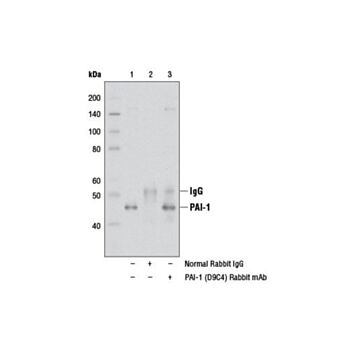
| Size | 100 µl |
| Reactivity | H Mk B |
| Sensitivity | Endogenous |
| Molecular Weight (kDa) | 48 |
| Source/Isotype | Rabbit IgG |
| Application/Dilution | {Western Blotting: 1:1000} |
| Storage | Supplied in 10 mM sodium HEPES (pH 7.5), 150 mM NaCl, 100 µg/ml BSA, 50% glycerol and less than 0.02% sodium azide. Store at –20°C. Do not aliquot the antibody. |
| Specificity/Sensitivity | PAI-1 (D9C4) Rabbit mAb recognizes endogenous levels of total PAI-1 protein. |
| Species Reactivity | Human, Monkey, Bovine |
| Source/Purification | Monoclonal antibody is produced by immunizing animals with a synthetic peptide corresponding to residues surrounding Arg294 of human PAI-1 protein. |
| Background | PAI-1 is a secreted protein that belongs to the serine proteinase inhibitor (serpin) superfamily. It inhibits urokinase and tissue plasminogen activators (uPA and tPA) and thus, reduces the conversion of inactive plasminogen to plasmin (1). PAI-1 regulates fibrinolysis and plays an important role in vessel patency and tissue remodeling. Secreted PAI-1 interacts with the extracellular matrix (ECM) component vitronectin, thereby modulating cell-ECM interactions (2,3). PAI-1 is expressed in a variety of tissues with higher expression in liver, vascular endothelial cells, platelets, macrophages, and adipose tissue (1). Increased levels of PAI-1 are associated with deep vein thrombosis (4). Defects in PAI-1 cause plasminogen activator inhibitor-1 deficiency (PAI-1D), which is characterized by increased bleeding after injury or surgery (5). Research studies have shown that high levels of PAI-1 are associated with obesity, aging, insulin resistance, and type 2 diabetes (6-8). PAI-1 is transcriptionally regulated by TGF-β and mediates TGF-β-induced inhibition of cell migration and invasion in cancer cells (9). Studies have also shown PAI-1 to be involved in fibrosis (10). |
| SKU | CSIG-11907S |
|---|---|
| Featured | No |
| Supplier Part Number | 11907S |
| UM | EA |
| UNSPSC | 12352203 |
| Manufacturer | Cell Signaling |
| MSDS URL | Click here |
| Temperature | -20C |
| CountryOfOrigin | United States |
| ProductLine | CSIG |
| Qty | 1 |
| MinOrderQty | 1 |
| Weight | 7.000000 |
| Lead Time | 5 |
| Hazardous | N |
| ACT Ecolabel | No |