We use cookies to make your experience better. To comply with the new e-Privacy directive, we need to ask for your consent to set the cookies. Learn more.

Cell Signaling Mrp4/Abcc4 (D1z3w) Rabbit mAb
List Price
$342.39
Your Price
$342.39
Cell Signaling Mrp4/Abcc4 (D1z3w) Rabbit mAb - CSIG (Additional S&H or Hazmat Fees May Apply)
NETA PART:
CSIG-12857S
MFG.PART:
12857S
UNSPSC:
12352203
Manufacturer:
Cell Signaling


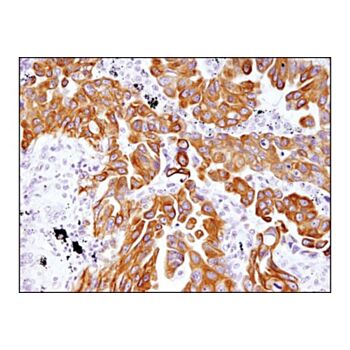
| Size | 100 µl |
| Reactivity | H M R |
| Sensitivity | Endogenous |
| Molecular Weight (kDa) | 140-200 |
| Source/Isotype | Rabbit IgG |
| Application/Dilution | {Western Blotting: 1:1000, Immunoprecipitation: 1:50, Immunohistochemistry (Paraffin): 1:1200} |
| Storage | Supplied in 10 mM sodium HEPES (pH 7.5), 150 mM NaCl, 100 µg/ml BSA, 50% glycerol and less than 0.02% sodium azide. Store at –20°C. Do not aliquot the antibody.For a carrier free (BSA and azide free) version of this product see product #71633. |
| Specificity/Sensitivity | MRP4/ABCC4 (D1Z3W) Rabbit mAb recognizes endogenous levels of total ABCC4 protein. This antibody cross-reacts with a nonspecific band at 47 kDa in some cell lines. |
| Species Reactivity | Human, Mouse, Rat |
| Source/Purification | Monoclonal antibody is produced by immunizing animals with a synthetic peptide corresponding to residues surrounding Gly192 of human ABCC4 protein. |
| Background | ABCC4 is a member of the ATP-binding Cassette (ABC) transporter family. ABC proteins transport various molecules across cellular membranes by utilizing the energy generated from ATP hydrolysis. There are seven subfamilies of ABC proteins: ABC1, MDR/TAP, MRP, ALD, OABP, GCN20, and White (1). ABCC4 belongs to the MRP subfamily, which is involved in multi-drug resistance, hence it is also named MRP4. ABCC4 is widely expressed in tissues including prostate, kidney proximal tubules, astrocytes and capillary endothelial cells of the brain, platelets, and many cancer cell lines (2-4). ABCC4 mediates efflux transport of a wide variety of endogenous and xenobiotic organic anionic compounds (5). The diversity of substrates determines the biological functions of ABCC4. It regulates cAMP levels in human leukemia cells, thereby controlling the proliferation and differentiation of leukemia cells (6). ABCC4 also enables COX deficient pancreatic cancer cells to obtain exogenous prostaglandins (7). Research studies have shown that ABCC4 expression is elevated in drug resistant cancer cells, which makes it a potential target for cancer therapy (8,9). ABCC4 localizes to both plasma membrane and intracellular membranous structures (10). Investigators have also implicated ABCC4 in the pathogenesis of Kawasaki disease, a childhood genetic disorder characterized by vasculitis (11). |
| SKU | CSIG-12857S |
|---|---|
| Featured | No |
| Supplier Part Number | 12857S |
| UM | EA |
| UNSPSC | 12352203 |
| Manufacturer | Cell Signaling |
| MSDS URL | Click here |
| Temperature | -20C |
| CountryOfOrigin | United States |
| ProductLine | CSIG |
| Qty | 1 |
| MinOrderQty | 1 |
| Weight | 7.000000 |
| Lead Time | 5 |
| Hazardous | N |
| ACT Ecolabel | No |