We use cookies to make your experience better. To comply with the new e-Privacy directive, we need to ask for your consent to set the cookies. Learn more.

Cell Signaling K63-Linkage Specific Polyubiquitin (D7a11) Rabbit mAb (Hrp Conjugate)
List Price
$481.77
Your Price
$481.77
Cell Signaling K63-Linkage Specific Polyubiquitin (D7a11) Rabbit mAb (Hrp Conjugate) - CSIG (Additional S&H or Hazmat Fees May Apply)
NETA PART:
CSIG-12930S
MFG.PART:
12930S
UNSPSC:
12352203
Manufacturer:
Cell Signaling


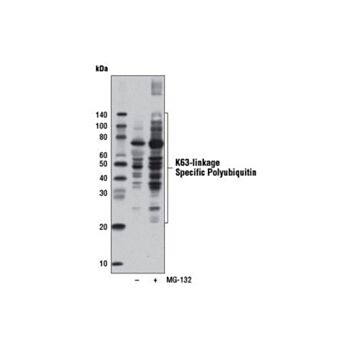
| Size | 100 µl |
| Reactivity | All |
| Sensitivity | Endogenous |
| Source/Isotype | Rabbit IgG |
| Application/Dilution | {Western Blotting: 1:1000} |
| Storage | Supplied in 136 mM NaCl, 2.6 mM KCI, 12 mM sodium phosphate (pH 7.4) dibasic, 2 mg/ml BSA, and 50% glycerol. Store at –20°C. Do not aliquot the antibodies. |
| Specificity/Sensitivity | K63-linkage Specific Polyubiquitin (D7A11) Rabbit mAb (HRP Conjugate) detects polyubiquitin chains formed by Lys63 residue linkage. It does not react with monoubiquitin or polyubiquitin chains formed by linkage to a different lysine residue. |
| Species Reactivity | All Species Expected |
| Source/Purification | Monoclonal antibody is produced by immunizing animals with a synthetic peptide corresponding to residues surrounding the Lys63 branch of the human diubiquitin chain. |
| Background | Ubiquitin is a conserved polypeptide unit that plays an important role in the ubiquitin-proteasome pathway. Ubiquitin can be covalently linked to many cellular proteins by the ubiquitination process, which targets proteins for degradation by the 26S proteasome. Three components are involved in the target protein-ubiquitin conjugation process. Ubiquitin is first activated by forming a thiolester complex with the activation component E1; the activated ubiquitin is subsequently transferred to the ubiquitin-carrier protein E2, then from E2 to ubiquitin ligase E3 for final delivery to the epsilon-NH2 of the target protein lysine residue (1-3). The ubiquitin-proteasome pathway has been implicated in a wide range of normal biological processes and in disease-related abnormalities. Several proteins such as IκB, p53, cdc25A, and Bcl-2 have been shown to be targets for the ubiquitin-proteasome process as part of regulation of cell cycle progression, differentiation, cell stress response, and apoptosis (4-7). |
| SKU | CSIG-12930S |
|---|---|
| Featured | No |
| Supplier Part Number | 12930S |
| UM | EA |
| UNSPSC | 12352203 |
| Manufacturer | Cell Signaling |
| MSDS URL | Click here |
| Temperature | -20C |
| CountryOfOrigin | United States |
| ProductLine | CSIG |
| Qty | 1 |
| MinOrderQty | 1 |
| Weight | 7.000000 |
| Lead Time | 5 |
| Hazardous | N |
| ACT Ecolabel | No |