We use cookies to make your experience better. To comply with the new e-Privacy directive, we need to ask for your consent to set the cookies. Learn more.

Cell Signaling O-Glcnac (Ctd110.6) Mouse mAb (Hrp Conjugate)
List Price
$481.77
Your Price
$481.77
Cell Signaling O-Glcnac (Ctd110.6) Mouse mAb (Hrp Conjugate) - CSIG (Additional S&H or Hazmat Fees May Apply)
NETA PART:
CSIG-12938S
MFG.PART:
12938S
UNSPSC:
12352203
Manufacturer:
Cell Signaling


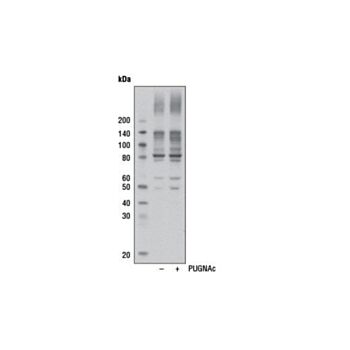
| Size | 100 µl |
| Reactivity | All |
| Sensitivity | Endogenous |
| Source/Isotype | Mouse IgM |
| Application/Dilution | {Western Blotting: 1:1000} |
| Storage | Supplied in 136 mM NaCl, 2.6 mM KCI, 12 mM sodium phosphate (pH 7.4) dibasic, 2 mg/ml BSA, and 50% glycerol. Store at –20°C. Do not aliquot the antibodies. |
| Specificity/Sensitivity | O-GlcNAc (CTD110.6) Mouse mAb (HRP Conjugate) specifically recognizes endogenous levels of O-GlcNAc on proteins in β-O-glycosidic linkage to both serine and threonine. |
| Species Reactivity | All Species Expected |
| Source/Purification | Monoclonal antibody is produced by immunizing animals with a peptide containing serine-O-linked N-acetylglucosamine (O-GlcNAc). |
| Background | A distinct form of protein glycosylation, beta-linked N-acetyl-glucosamine (GlcNAc) moieties can be added to serine or threonine residues of proteins (1,2). This differs from other forms of glycosylation, as it typically is a single moiety rather than the complex branched sugars that are more commonly studied. It is thought that these modifications happen in a much more dynamic cycle more reminiscent of phosphorylation modifications. GlcNAc modified proteins are found in the cytoplasm and nucleus and are modulated by means of specific O-GlcNAc transferases (OGT) as well as GlcNAcase activity that can be inhibited using the Thiamet-G (TMG) inhibitor. Mass spectrometry analysis of this modification has been complicated due to the loss of the GlcNAc group during ionization and fragmentation, but methods and technologies such as electron transfer dissociation (ETD) are opening up new avenues to study these modifications. O-GlcNAc could play an important role in many cellular processes, including metabolism, growth, morphogenesis, apoptosis, transcription, and it may play a critical role in cancer (3). |
| SKU | CSIG-12938S |
|---|---|
| Featured | No |
| Supplier Part Number | 12938S |
| UM | EA |
| UNSPSC | 12352203 |
| Manufacturer | Cell Signaling |
| MSDS URL | Click here |
| Temperature | -20C |
| CountryOfOrigin | United States |
| ProductLine | CSIG |
| Qty | 1 |
| MinOrderQty | 1 |
| Weight | 7.000000 |
| Lead Time | 5 |
| Hazardous | N |
| ACT Ecolabel | No |