We use cookies to make your experience better. To comply with the new e-Privacy directive, we need to ask for your consent to set the cookies. Learn more.

Cell Signaling Phospho-Mcm2 (Ser139) (D1z8x) Xp Rabbit mAb
List Price
$435.31
Your Price
$435.31
Cell Signaling Phospho-Mcm2 (Ser139) (D1z8x) Xp Rabbit mAb - CSIG (Additional S&H or Hazmat Fees May Apply)
NETA PART:
CSIG-12958S
MFG.PART:
12958S
UNSPSC:
12352203
Manufacturer:
Cell Signaling


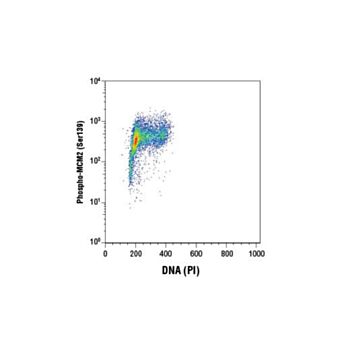
| Size | 100 µl |
| Reactivity | H M R Hm Mk Dg |
| Sensitivity | Endogenous |
| Molecular Weight (kDa) | 125 |
| Source/Isotype | Rabbit IgG |
| Application/Dilution | {Western Blotting: 1:1000, Immunoprecipitation: 1:50, Immunofluorescence (Immunocytochemistry): 1:100, Flow Cytometry (Fixed/Permeabilized): 1:200} |
| Storage | Supplied in 10 mM sodium HEPES (pH 7.5), 150 mM NaCl, 100 µg/ml BSA, 50% glycerol and less than 0.02% sodium azide. Store at –20°C. Do not aliquot the antibody. |
| Specificity/Sensitivity | Phospho-MCM2 (Ser139) (D1Z8X) XP® recognizes endogenous levels of MCM2 protein only when phosphorylated at Ser139. |
| Species Reactivity | Human, Mouse, Rat, Hamster, Monkey, Dog |
| Source/Purification | Monoclonal antibody is produced by immunizing animals with a synthetic peptide corresponding to residues surrounding Ser139 of human MCM2 protein. |
| Background | The minichromosome maintenance (MCM) 2-7 proteins are a family of six related proteins required for initiation and elongation of DNA replication. MCM2-7 bind together to form the heterohexameric MCM complex that is thought to act as a replicative helicase at the DNA replication fork (1-5). This complex is a key component of the pre-replication complex (pre-RC) (reviewed in 1). Cdc6 and CDT1 recruit the MCM complex to the origin recognition complex (ORC) during late mitosis/early G1 phase forming the pre-RC and licensing the DNA for replication (reviewed in 2). Licensing of the chromatin permits the DNA to replicate only once per cell cycle, thereby helping to ensure that genetic alterations and malignant cell growth do not occur (reviewed in 3). Phosphorylation of the MCM2, MCM3, MCM4, and MCM6 subunits appears to regulate MCM complex activity and the initiation of DNA synthesis (6-8). CDK1 phosphorylation of MCM3 at Ser112 during late mitosis/early G1 phase has been shown to initiate complex formation and chromatin loading in vitro (8). Phosphorylation of MCM2 at serine 139 by cdc7/dbf4 coincides with the initiation of DNA replication (9). MCM proteins are removed during DNA replication, causing chromatin to become unlicensed through inhibition of pre-RC reformation. Studies have shown that the MCM complex is involved in checkpoint control by protecting the structure of the replication fork and assisting in restarting replication by recruiting checkpoint proteins after arrest (reviewed in 3,10). |
| SKU | CSIG-12958S |
|---|---|
| Featured | No |
| Supplier Part Number | 12958S |
| UM | EA |
| UNSPSC | 12352203 |
| Manufacturer | Cell Signaling |
| MSDS URL | Click here |
| Temperature | -20C |
| CountryOfOrigin | United States |
| ProductLine | CSIG |
| Qty | 1 |
| MinOrderQty | 1 |
| Weight | 7.000000 |
| Lead Time | 5 |
| Hazardous | N |
| ACT Ecolabel | No |