We use cookies to make your experience better. To comply with the new e-Privacy directive, we need to ask for your consent to set the cookies. Learn about our cookie policy.

Cell Signaling Toll-Like Receptor 9 (D9m9h) Xp Rabbit mAb
List Price $162.61 Your Price $162.61
Cell Signaling Toll-Like Receptor 9 (D9m9h) Xp Rabbit mAb - CSIG (Additional S&H or Hazmat Fees May Apply)
NETA PART: CSIG-13674T
MFG.PART: 13674T
UNSPSC: 12352203
Manufacturer: Cell Signaling


| Size | 20 µl |
| Reactivity | H |
| Sensitivity | Endogenous |
| Molecular Weight (kDa) | 130 |
| Source/Isotype | Rabbit IgG |
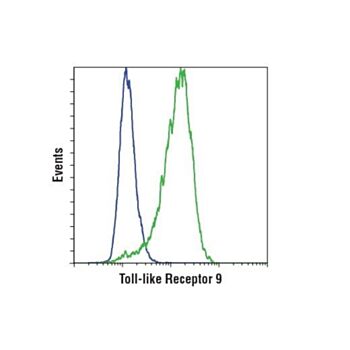
| Application/Dilution | {Western Blotting: 1:1000, Immunoprecipitation: 1:50, Immunofluorescence (Immunocytochemistry): 1:400 - 1:1600, Flow Cytometry (Fixed/Permeabilized): 1:100 - 1:400} |
| Storage | Supplied in 10 mm sodium HEPES (pH 7.5), 150 mm NaCl, 100 µg/mL BSA, 50% glycerol and less than 0.02% sodium azide. Store at –20°C. Do not aliquot the antibody. |
| Specificity/Sensitivity | Toll-like Receptor 9 (D9M9H) XP® Rabbit mAb recognizes endogenous levels of total Toll-like receptor 9 protein. This antibody is predicted to recognize known full-length isoforms of Toll-like receptor 9, but not cleaved Toll-like receptor 9 protein. |
| Species Reactivity | Human |
| Source/Purification | Monoclonal antibody is produced by immunizing animals with a synthetic peptide corresponding to residues surrounding Pro450 of human Toll-like receptor 9 protein. |
| Background | Members of the Toll-like receptor (TLR) family, named for the closely related Toll receptor in Drosophila, play a pivotal role in innate immune responses (1-4). TLRs recognize conserved motifs found in various pathogens and mediate defense responses (5-7). Triggering of the TLR pathway leads to the activation of NF-κB and subsequent regulation of immune and inflammatory genes (4). The TLRs and members of the IL-1 receptor family share a conserved stretch of approximately 200 amino acids known as the Toll/Interleukin-1 receptor (TIR) domain (1). Upon activation, TLRs associate with a number of cytoplasmic adaptor proteins containing TIR domains, including myeloid differentiation factor 88 (MyD88), MyD88-adaptor-like/TIR-associated protein (MAL/TIRAP), Toll-receptor-associated activator of interferon (TRIF), and Toll-receptor-associated molecule (TRAM) (8-10). This association leads to the recruitment and activation of IRAK1 and IRAK4, which form a complex with TRAF6 to activate TAK1 and IKK (8,11-14). Activation of IKK leads to the degradation of IκB, which normally maintains NF-κB in an inactive state by sequestering it in the cytoplasm.TLR9 is highly expressed in macrophages, dendritic cells, and B lymphocytes, and in humans has five isoforms generated by alternative splicing (15,16). TLR9 binds to unmethylated CpG motifs present on bacterial DNA and stimulates NF-κB via the MyD88 adaptor protein (17-19). In contrast to most TLR family members that are localized to the plasma membrane, TLR9 is an intracellular receptor localized to the ER in resting cells (20). Upon binding to CpG DNA, TLR9 is proteolytically processed and translocates to endo-lysosomal compartments where it binds MyD88, initiating downstream signaling (21-23). |
| SKU | CSIG-13674T |
|---|---|
| Supplier Part Number | 13674T |
| UM | EA |
| UNSPSC | 12352203 |
| Manufacturer | Cell Signaling |
| MSDS URL | Click here |
| Temperature | -20C |
| CountryOfOrigin | United States |
| ProductLine | CSIG |
| Qty | 1 |
| MinOrderQty | 1 |
| Weight | 7.000000 |
| Lead Time | 5 |
| Hazardous | N |
| Energy Star | No |
| Green | No |
| Controlled | N |