We use cookies to make your experience better. To comply with the new e-Privacy directive, we need to ask for your consent to set the cookies. Learn more.

Cell Signaling Vinculin (E1e9v) Xp<Lt/>Sup≫®<Lt/>/Sup≫ Rabbit mAb
List Price
$176.75
Your Price
$176.75
Cell Signaling Vinculin (E1e9v) XpSup≫®/Sup≫ Rabbit mAb - CSIG (Additional S&H or Hazmat Fees May Apply)
NETA PART:
CSIG-13901T
MFG.PART:
13901T
UNSPSC:
12352203
Manufacturer:
Cell Signaling


| Size | 20 µl |
| Reactivity | H M R Mk |
| Sensitivity | Endogenous |
| Molecular Weight (kDa) | 124 |
| Source/Isotype | Rabbit IgG |
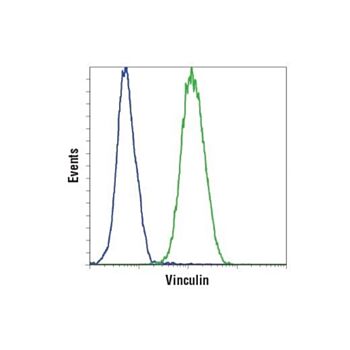
| Application/Dilution | {Western Blotting: 1:1000, Simple Western™: 1:10 - 1:50, IHC Leica Bond: 1:600 - 1:2400, Immunohistochemistry (Paraffin): 1:150 - 1:600, Flow Cytometry (Fixed/Permeabilized): 1:800 - 1:1600} |
| Storage | Supplied in 10 mM sodium HEPES (pH 7.5), 150 mM NaCl, 100 µg/ml BSA, 50% glycerol and less than 0.02% sodium azide. Store at –20°C. Do not aliquot the antibody.For a carrier free (BSA and azide free) version of this product see product #40211. |
| Specificity/Sensitivity | Vinculin (E1E9V) XP® recognizes endogenous levels of total vinculin protein. This antibody also reacts with metavinculin, a 145 kDa splice variant of vinculin. |
| Species Reactivity | Human, Mouse, Rat, Monkey |
| Source/Purification | Monoclonal antibody is produced by immunizing animals with recombinant protein specific to the amino terminus of human vinculin protein. |
| Background | Vinculin is a cytoskeletal protein that plays an important role in the regulation of focal adhesions and embryonic development (1-4). Three structural vinculin domains include an amino-terminal head, a short, flexible proline-rich region and a carboxy-terminal tail (1). In the inactive state, the head and tail domains of vinculin interact to form a closed confirmation. The open and active form of vinculin translocates to focal adhesions where it is thought to be involved in anchoring F-actin to the membrane and regulation of cell migration (2). Phospholipid binding to the tail domain and subsequent phosphorylation of vinculin at Ser1033 and Ser1045 by PKC-α and Tyr100 and Tyr1065 by Src kinases weakens the head-tail interaction (5,6). This change in vinculin allows the binding of a number of other proteins, including talin, α-actinin and paxillin, which disrupts the head-tail interaction and initiates the conformational change from the inactive to active state (2,4). Vinculin deficiencies are associated with a decrease in cell adhesion and an increase in cell motility, suggesting a possible role in metastatic growth (7,8). This is supported by a demonstrated relationship between decreased vinculin expression and increased carcinogenesis and metastasis in colorectal carcinoma (9). |
| SKU | CSIG-13901T |
|---|---|
| Featured | No |
| Supplier Part Number | 13901T |
| UM | EA |
| UNSPSC | 12352203 |
| Manufacturer | Cell Signaling |
| MSDS URL | Click here |
| Temperature | -20C |
| CountryOfOrigin | United States |
| ProductLine | CSIG |
| Qty | 1 |
| MinOrderQty | 1 |
| Weight | 7.000000 |
| Lead Time | 5 |
| Hazardous | N |
| ACT Ecolabel | No |